
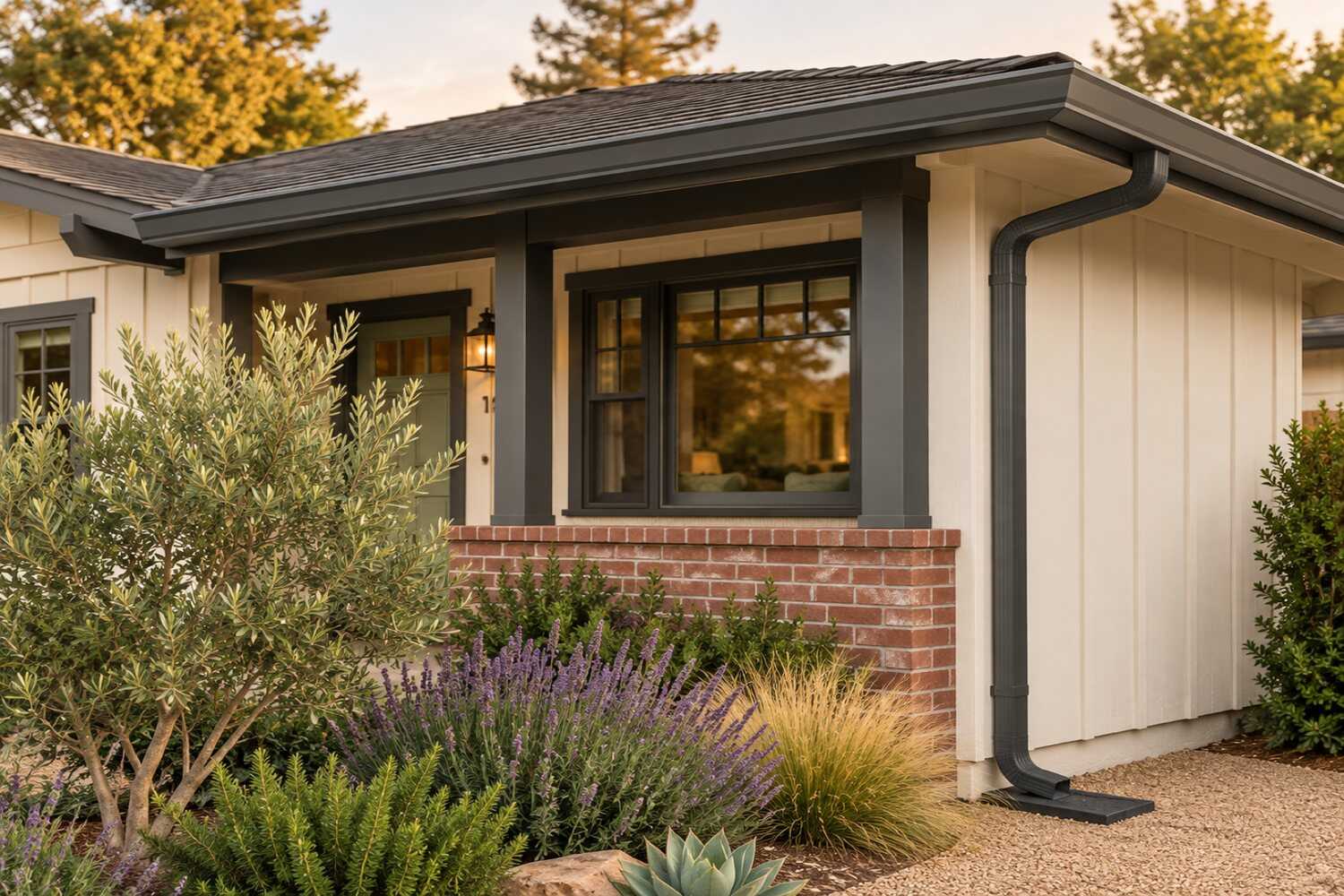
Gutter installation and gutter guards in Sacramento, CA.
Sacramento gutter planning starts with the actual roof, nearby trees and discharge route. Compare debris and access on a tree-lined central-city lot with the conditions at a Natomas property, then measure the system and inspect fascia and drains before choosing repairs, replacement or guards.
What gutter installation costs in Sacramento
Published Sacramento figures put a new 5-inch seamless aluminum system on a 150–200 foot house at about $2,200–$3,800 (Sacramento Gutter Guard) and $2,200–$4,500 for an average home (GutterFX). Guards add roughly $1,500–$3,500 and each extra downspout $100–$250. Two-story eaves, rotted fascia, box-gutter conversions and buried-drain work are the local adders.
| Scope | Published range | What it usually includes |
|---|---|---|
| GutterFX added-downspout allowance | $100–$250 each | The Sacramento guide’s published downspout allowance. It should not be read as a complete gutter repair or underground-drain price; the route, length, fittings and discharge point need their own scope. |
| Sacramento Gutter Guard 150–200 ft example | $2,200–$3,800 | Its published 5-inch seamless-aluminum house example. GutterFX’s separate 2025 Sacramento guide publishes $2,200–$4,500 for an average home. Compare gutter length, downspouts, removal and fascia work before treating the figures as equivalent. |
| GutterFX guard-installation allowance | $1,500–$3,500 | Its published guard range. Sacramento Gutter Guard separately lists $6–$18 per linear foot for guards. Confirm product, measured length and attachment details; a price does not establish which mesh suits a particular tree or roof. |
Ranges are published third-party figures, not 916 Exteriors prices; the written estimate is the only number that applies to your home.
How to compare these ranges
Sacramento publishers use different house sizes and inclusion lists, so their endpoints should stay separate. Measure each run and note corners, outlets, profile and downspout routes.
Two-story eaves in the Pocket or Natomas can need different access from a ground-level ranch, while old box gutters and concealed fascia on central-city homes need inspection before a replacement scope is settled. Price rotten backing separately and test any buried drain before connecting new outlets.
A guard option should state its product and maintenance access. These planning figures become useful only after the proposal describes the same measured system.
Read next: How much does gutter installation cost in Sacramento?
What changes the price in Sacramento
- Two-story eaves
- Greenhaven, the Pocket, South Natomas, and North Natomas are mostly two-story; second-floor runs need a lift or staged ladders and add labor per foot.
- Fascia behind the old gutter
- Swollen hardboard on 1980s tracts and rotted redwood behind prewar box gutters are replaced before anything is hung, priced per foot as a separate line.
- Box gutter conversion
- Relining or closing a built-in gutter on a Land Park or Curtis Park Tudor is carpentry and sheet-metal work on top of the gutter itself.
- Downspout routing
- Extensions across a lawn are cheap; locating and testing an old underground drain in the central city, or piping to a curb outlet on Natomas clay, is not.
- Tile roof edge
- Natomas tile roofs need the gutter fastened through the fascia below the tile with the bird stops preserved, which is slower than hanging under composition shingle.
- Historic profile
- Half-round aluminum or copper on a contributing house in Boulevard Park or Newton Booth costs more per foot than K-style and takes longer to fabricate.
- Lead-safe work on pre-1978 fascia
- Confirm building age and the applicable EPA RRP handling before disturbing painted fascia; do not infer an exact eligible share from ACS decade groups.
- Street access and canopy
- Lifts on the Fabulous Forties and Land Park mean a parking plan and working around city-maintained trees that need a permit to prune.
Compare gutters and guards
Choose two options to compare the upkeep, fit and installation details.
| Compare | Seamless aluminum gutters | Steel or copper gutters |
|---|---|---|
| Appearance | Continuous runs; many baked-on colors | Heavier profile; copper weathers to a patina |
| Maintenance | Cleaning; check outlets and hangers | Similar cleaning; copper needs compatible fasteners |
| Where it fits | Most homes; 5-inch or 6-inch profile sized to the roof | Design-led homes or heavy-debris settings |
| Installation | Formed on site to exact length; hidden hangers | Higher material cost; specialty fabrication |
View all 5 options and planning notes
Seamless aluminum, formed on site to the exact run length, is the standard replacement gutter in the region and the best value; steel and copper cost more and suit specific homes. Among guards, micro-mesh keeps out needles and seeds and is the usual choice under oak and pine, perforated screens are cheapest and pass small debris, and reverse-curve hoods can overshoot in the heavy winter storms that Sacramento gets.
| Option | Appearance | Maintenance | Where it fits | Installation notes |
|---|---|---|---|---|
| Seamless aluminum gutters | Continuous runs; many baked-on colors | Cleaning; check outlets and hangers | Most homes; 5-inch or 6-inch profile sized to the roof | Formed on site to exact length; hidden hangers |
| Steel or copper gutters | Heavier profile; copper weathers to a patina | Similar cleaning; copper needs compatible fasteners | Design-led homes or heavy-debris settings | Higher material cost; specialty fabrication |
| Micro-mesh guards | Low-profile screen that follows the gutter | Occasional brushing; fine debris can film the mesh | Trees with needles, seeds, and small leaves | Fastened to the gutter and tucked under shingles or to fascia |
| Perforated or screen guards | Visible panel over the gutter | Larger openings pass small debris; periodic clearing | Broad-leaf trees | Simplest to install and remove |
| Reverse-curve guards | Solid hood with a slot at the front | Can overshoot in heavy rain; slot needs clearing | Moderate debris, gentler roof pitches | Usually tied to the roof edge; check roofing warranty terms |
Guard performance depends on the trees over the roof and the roof pitch; no guard makes a gutter maintenance-free.
Planning gutters work in Sacramento
Open the topics that apply to your property.
Gutter work in Sacramento differs from its neighbors in three ways. Drainage first: the city is pumped, not gravity-drained, and the central city’s combined sewer means an old downspout drain may be a connection the Department of Utilities regulates. Arden-Arcade and Carmichael are unincorporated and settle drainage questions with Sacramento County. Housing age second: 11% of city housing predates 1940 and 30% predates 1960 (ACS 2020–2024), against 1% and 37% in Arden-Arcade and 0% and 1% in Elk Grove. Box gutters, half-round profiles and rotted redwood fascia are Sacramento problems that an Elk Grove crew rarely meets. Trees third: the city’s own street trees hang over most central-city roofs and carry a permit rule. West Sacramento, across the river in Yolo County, has its own building division, young street trees and a stock that is 43% post-2000 Southport stucco.
Compare nearby: Arden-Arcade gutter installation · Elk Grove gutter installation · Rancho Cordova gutter installation
Gutter installation for Sacramento homes
Gutters in Sacramento do a job that most valley cities can leave to gravity. The city sits at low elevation inside a ring of levees, and its Department of Utilities notes that all the rain falling inside them has to be pumped out. A downspout that dumps against a foundation on Natomas clay, or into a collapsed clay drain in Land Park, puts water where the pumps never see it. Roughly 18 inches fall each winter, nearly all between November and March. Much of it arrives in a few atmospheric-river storms that overwhelm an undersized outlet in minutes. The housing the gutters hang on is old by regional standards. The median build year is 1977, with 18% built before 1950 and 36% between 1950 and 1979 (U.S. Census Bureau, ACS 2020–2024 5-year), and nearly all of it carries painted wood fascia.
What crews find depends on the street. The prewar blocks of Boulevard Park, Newton Booth, Poverty Ridge, Curtis Park and Land Park still carry built-in box gutters and half-round steel on some houses. Their downspouts disappear into the ground and run, when they still run, toward the combined stormwater-and-sewer system that serves the older central city. Postwar ranches in River Park, Tahoe Park and Meadowview have sectional aluminum on spike-and-ferrule hangers, pulling out of fascia that the last gutter overflowed onto for decades. The two-story stucco tracts of Greenhaven, the Pocket and Natomas have first-generation seamless aluminum, often on hardboard fascia. Their upper roofs drain onto lower ones, and their outlets never got extensions.
The estimate should follow the water. Measure each run and count the outlets. Name the profile and hanger, show where every downspout ends, and state what happens to a downspout that currently goes underground. The crew inspects the fascia behind the old gutter before new hangers go in and prices it per foot as its own line. Guards are a product decision made against the actual trees over the roof, with cleaning access written in. The gutter service scope and the gutter guard comparison lay out how those pieces separate in a written scope.
Trees are the other Sacramento variable. The city owns the trees in its park strips and requires a permit for work on them. The same ordinance protects native oaks and sycamores over 12 inches in diameter on private land. So the gutter design follows the canopy, not the other way round. On a Fabulous Forties or Elmhurst house the load is leaf, seed and twig litter for months of the year. On a North Natomas tract it is dust and roof grit. That difference decides guard type, downspout count and how often anyone climbs a ladder, and it belongs in the written scope before a guard price does.
Housing age and what to inspect
Housing age helps plan an inspection. The share of homes in each decade is census data; the notes describe materials and conditions to check at the property.
| Built | Share of homes |
|---|---|
| Before 1940 | 11% |
| 1940–1949 | 7% |
| 1950–1959 | 12% |
| 1960–1969 | 11% |
| 1970–1979 | 13% |
| 1980–1989 | 15% |
| 1990–1999 | 8% |
| 2000–2009 | 15% |
| 2010 and later | 8% |
Sacramento: 212,485 housing units, median year built 1977, median owner-occupied value $506,300, 52% owner-occupied. Source: U.S. Census Bureau, American Community Survey 2020–2024 5-Year Estimates, tables B25034 (year structure built), B25035 (median year built), B25077 (median value, owner-occupied), B01003, B25003 (ACS 2024 5-year).
- Before 1940Before 1940 · about 11% of Sacramento homes
- Prewar Sacramento houses in Boulevard Park, Newton Booth, Poverty Ridge, Curtis Park and Land Park have two gutter types that no tract house has. One is the box gutter framed into the eave and lined with sheet metal. The other is half-round steel hung on straps. Box-gutter liners pinhole at the seams, water gets into the eave framing, and the rot shows up years later as a soft fascia or a stained soffit. The downspouts often drop into clay or cast-iron leaders that run underground toward the central city’s combined sewer, and many have collapsed. The estimate should offer relining or closing the box as carpentry and sheet-metal lines. It should test every buried leader before reconnecting to it. A visible profile change on a contributing house is a preservation question. Fascia paint on these houses counts as lead-bearing under the EPA rule until a test says otherwise.
- 1940s1940s · about 7% of homes
- The 1945 Tahoe Terrace subdivision and the first River Park lots of 1947–48 have low hip roofs with short eaves and 1x6 redwood fascia. Where original, the gutters are galvanized steel K-style or half-round in short sections. Most gave way long ago to sectional aluminum that now leaks at every slip joint. A 5-inch seamless run on hidden hangers is the usual replacement. The scope should also check the roof’s drip edge, which is often missing and lets water run behind the gutter onto the fascia. Price fascia replacement per foot before hanging anything.
- 1950s1950s · about 12% of homes
- The 1950s filled the rest of River Park and built the 1955–56 Eichlers of South Land Park Hills. Both belong to the more than 48,000 parcels the city’s mid-century survey identified as potentially built in the 1940s through 1960s. Ranch houses of this decade have wide eaves with exposed rafter tails and no fascia at all on some elevations. The gutter hangs from the rafter tails or a roof strap, so the hanger choice belongs in the scope. Eichler flat roofs use scuppers and short leaders instead of a perimeter gutter. Adding gutters there changes a designated house’s appearance and warrants a preservation check. Rafter-tail rot found under an old gutter is a carpentry line, and a structural one if the tail carries the roof edge.
- 1960s1960s · about 11% of homes
- Greenhaven ’70, begun in 1961 as a planned community around a central greenbelt, and the Meadowview tracts of the same decade are low-pitch composition-shingle ranches on lots graded to drain to the street. Their gutters are usually second- or third-generation aluminum on spike-and-ferrule hangers. The spikes have worked loose, and the fascia joints behind them are soft. The scope should replace spikes with hidden hangers into sound wood, price fascia per foot, and run downspouts to the front where the grading takes them. Long straight runs may need a second outlet or a 6-inch profile at the valley end. That call comes from the roof area collected, not from house size.
- 1970s and 1980s1970s and 1980s · about 28% of homes combined
- The Pocket’s build-out inside the river bend and the later South Natomas subdivisions are two-story houses with upper roofs draining onto lower ones. They have hardboard fascia and, on some late-1980s custom homes, concrete tile roofs. Hardboard fascia swells and rots behind the gutter, and it comes off before anything new goes up. Where an upper downspout lands on a lower roof, the lower gutter needs an outlet at that corner and a splash guard at the inside miter. Under tile the gutter fastens to the fascia below the bird stops, which is slower than working under composition shingle. Second-floor runs need a lift or staged ladders on Pocket lots, and that is a separate line.
- 1990s and 2000s1990s and 2000s · about 23% of homes combined
- North Natomas, from the first mid-1990s tracts through Natomas Park and Westlake, is concrete tile over stucco with wrapped fascia, on flat clay lots inside the FEMA A99 flood zone. Some downspouts went into buried lines to the curb when the tracts went up, and those lines silt up or crush under driveways. The scope should water-test each buried line before reconnecting to it and add extensions to grade where a line has failed. Match the gutter color to the trim for the HOA. Inside corners at the entry roofs concentrate flow and are the usual overflow point, so an extra outlet there beats a larger profile everywhere. Gutters also get in the way of solar work. The proposal should say whether existing runs stay, come down temporarily or get replaced.
- 2010 and later2010 and later · about 8% of homes
- The newest 8% is North Natomas infill plus central-city infill on Midtown and Oak Park lots. Some builder-grade systems are 5-inch aluminum hung only where the plans required it, which leaves porch and garage roofs without collection. The proposal should show which roof sections have gutters now, which do not, and where new runs discharge. The flood-zone lots in Natomas are flat, and Midtown lots often have an alley behind them. Evaluate guards against real debris, which on a new Natomas street with young trees is mostly grit. Keep roof and solar warranties in mind before anyone fastens through a new roof edge.
Gutters by neighborhood in Sacramento
- Land Park
- Land Park’s Tudor and Spanish Revival houses around William Land Park commonly carry built-in box gutters, many still lined with the original sheet metal. A soft fascia or stained soffit there usually means the liner has failed. The choice is relining the box or closing it and hanging a conventional gutter, and both are carpentry as much as sheet-metal work. Downspouts into old clay leaders toward the combined sewer get a water test first. A collapsed leader gets a reroute to grade, not a reconnection.
- East Sacramento and the Fabulous Forties
- The Fabulous Forties, on the largest lots in East Sacramento between 38th and 47th Streets, have steep two-story roofs whose valleys concentrate runoff at a few corners. City-maintained street trees overhead shed litter for months. The plan should show the receiving gutter and outlet at each valley and add outlets there before upsizing the whole perimeter. A lift on the street means a parking plan. The street trees, including a century-old deodar cedar, need a city permit before any pruning for access. Half-round or copper on a contributing house is its own profile, priced per foot.
- Midtown, Boulevard Park, and Newton Booth
- Boulevard Park is about 300 buildings on the 1905 subdivision of the old fairgrounds and the largest National Register neighborhood in Sacramento, and Newton Booth sits next to it. Both are contributing-house territory. A visible change from half-round to K-style on a street-facing eave is a preservation question before it is a fabrication order. Midtown alley lots have side yards a few feet wide, so downspouts run to the alley or the front, and sharing a discharge with the neighbor is a conversation, not an assumption. Include restoration of any painted trim disturbed by hanger removal, with lead-safe practice on the fascia.
- Curtis Park
- Curtis Park’s Craftsman bungalows carry wide eaves with exposed rafter tails and a bed molding instead of a flat fascia. A K-style gutter cannot simply screw to a board there. The estimate should say how the gutter attaches, whether a fascia board goes on and how that changes the eave’s look, and how the crew inspects the rafter tails behind it. A rotted tail is a carpentry line, and on a bungalow with a heavy roof it can be a structural one. Trim primer and finish on any new board belong in the scope, not with a painter later.
- Oak Park
- Oak Park, the city’s first suburb on its grid of numbered streets and avenues, has cottage-scale houses with detached garages and porch roofs that drain toward the main roof or toward each other. Measure the garage and porch runs separately and count their outlets. A whole-house price can leave a garage roof dumping onto the side yard. Early-2000s investor rehabs can have gutters hung over unrepaired fascia, so probe the wood before reusing any run.
- Tahoe Park
- Tahoe Park’s small stucco houses south of Highway 50, built out from the 1945 Tahoe Terrace subdivision onward, have short low eaves that a single ladder reaches. That keeps a full replacement near the bottom of the published Sacramento ranges. The debris load comes from the street trees, not the roof, so guard selection follows the actual leaf and seed fall on each side of the house. Downspouts here go to grade extensions toward the front, and the scope should say which corners get one.
- River Park
- River Park is a two-mile cul-de-sac between the railroad levee and the American River levee, with two entrances on H Street. Its 1947–1950s ranches sit under mature yard trees and the river canopy along the levee. Gutters fill several times a winter, and the outlet route across a landscaped front yard matters more than the profile. Inspect the discharge point near walkways and planting beds, test any old extension or buried pipe, and separate gutter work from anything downstream. Native oaks over 12 inches in diameter here are protected trees, so the design fits the canopy instead of trimming it.
- Pocket and Greenhaven
- The Pocket-Greenhaven bend sits slightly below sea level at its center and drains to the street by grading. Downspout outlets on these 1960s–1990s houses belong at the front, not in a back-yard planter. Two-story custom homes from the 1980s build-out have upper roofs draining onto lower ones. Record where the overflow shows, at a run, a valley or an outlet, since each points to a different fix. Lakefront lots on the old brickyard pit take unshaded west weather. Splash guards at inside miters and a second outlet usually beat a larger profile.
- North Natomas and Natomas Park
- North Natomas went up from the mid-1990s on flat Natomas Basin clay inside the FEMA A99 flood zone. It has tile roofs, wrapped fascia and, on many lots, buried drain lines to the curb that silt up or crush. Water-test every buried line before reconnecting a new downspout to it, and add grade extensions where a line has failed. Coordinate with any planned roof or solar work, and state whether runs stay or come down. Match gutter color to the trim for the Natomas Park association. Entry-roof inside corners are the standard overflow point.
- Meadowview
- Meadowview’s 1960s ranches at the south edge of the city have long straight eaves on low-pitch roofs. Their gutters hang on spike-and-ferrule hangers that have loosened in the fascia joints. The plan should say how the crew verifies attachment where backing is soft, what it can check before removal, and how it prices additional fascia per foot. Photograph findings and get written approval before the run grows. New fasteners into rotten wood are not a repair.
- Elmhurst
- Elmhurst, laid out around 1908 along T Street, has the elm, ash and oak canopy its name promises. Its bungalow gutters take leaf litter from October into January. Compare an open gutter and a guarded one on the same run lengths and outlets, and pick the guard for elm seed and ash leaves, not from a catalog. Cleaning access stays in the scope either way. On these pre-1978 houses the crew inspects the fascia behind the old gutter and handles painted wood with lead-safe practice.
- South Natomas
- South Natomas, subdivided from the 1950s to the 1980s between the river and Interstate 80, mixes single-story stucco ranches with later two-story tracts. One street can need both a simple 5-inch replacement and a second-floor run with a lift. Ask the guard proposal for the exact product, attachment and cleaning access, and read the warranty for its maintenance conditions. A guard does not change the need to inspect the discharge route on these flat lots.
Sun, rain, trees and site conditions
Sacramento sits in California Energy Commission climate zone 12, on the valley floor. About 18 inches of rain fall nearly all between November and March, often in a few atmospheric-river storms that can drop an inch or more in a day. Those storms are what a gutter is sized for. A valley on a Fabulous Forties roof or an inside corner on a Natomas entry roof concentrates flow at one outlet. Overflow at that spot means an outlet or splash-guard problem, not a profile problem. Summer matters too. Aluminum expands on 100°F days, so long runs need expansion room at the ends, and sun-baked sealant at the miters is where the first winter leak appears.
The city’s trees set the maintenance load. Sacramento maintains the trees in its park strips and requires a permit for work on them. The same ordinance protects native oaks and sycamores over 12 inches in diameter on private lots, so the gutter design follows the canopy. Under the elms, ash and oaks of Elmhurst and the Fabulous Forties, or the river trees of River Park, the choice is a guard matched to leaf and seed litter or a cleaning schedule, and the scope says which. In North Natomas and Meadowview the load is grit and dust. A fine mesh guard can trap it and cause overflow of its own.
Water has nowhere to go on its own here. Levees surround the city and it pumps its stormwater out. The Natomas Basin is a FEMA A99 flood zone on flat clay. The Pocket bend sits slightly below sea level at its center. The older central city drains through a combined stormwater-and-sewer system with old clay leaders that have often collapsed. So the discharge point is a design item: extensions to the lawn in Natomas, outlets to the street in Greenhaven, a water-tested leader or a reroute to grade in Land Park. Roughly 54% of the housing predates 1980, so painted fascia gets lead-safe handling when hangers come out.
Permits and approvals
Replacing gutters and downspouts like for like does not normally require a building permit in the City of Sacramento. The work that can pull a gutter job into the permit system is what is found behind the gutter: rotted rafter tails, roof sheathing, or a section of the eave framing are structural repairs, and structural repair is permitted through the City of Sacramento Community Development Department, Building Division. When a gutter scope turns into that, the repair is written as its own line, the permit is named in it, and who pulls it is stated. Fascia board replacement alone does not.
Underground drains are the other trigger. Surface discharge must still avoid nuisance, property-line and drainage problems; confirm the proposed route where local requirements may apply. Piping it to the street through a curb outlet, tying it into an existing drain that runs to the combined sewer, or connecting anything to a public storm drain involves the City of Sacramento Department of Utilities, which regulates connections to the storm drain system under the city's stormwater ordinance (City Code Chapter 13.16). Downspouts are routed to grade or to a drain the owner already has; if a curb outlet or a new public connection is the right answer, the estimate says so and leaves the approval to the city.
Two review layers apply to older houses. In a designated historic district (Boulevard Park, Newton Booth, Poverty Ridge, Alkali Flat, Southside Park, and 20th Street among them), a like-for-like gutter is usually a minor matter, but a visible change on a street-facing eave, half-round to K-style, or a new material, is the kind of thing worth asking the city's Preservation staff about before the order goes in; the estimate flags it when the address is in a district. Separately, on a confirmed pre-1978 home, subject to the scope and any applicable exemption, the federal EPA Renovation, Repair and Painting rule applies whenever fascia paint is disturbed by hanger removal, scraping, or board replacement, and the work is done with lead-safe practices by a certified firm. HOA architectural review is mostly a Natomas question and usually amounts to matching the gutter color to the trim.
Permit authority: City of Sacramento Community Development, Building Division . Whether a permit or review applies, and who pulls it, is written into the estimate.
Seeing something on your own house? Request an estimate for gutters in Sacramento
Repair, reseal, or replace?
Gutters fail at seams, hangers, and outlets before the runs themselves wear out. The fix depends on where the problem is.
Not sure which applies? Tell us what you are seeing and request an estimate for gutters.
What the scope includes
A complete estimate names the work, materials and exclusions so you can compare proposals.
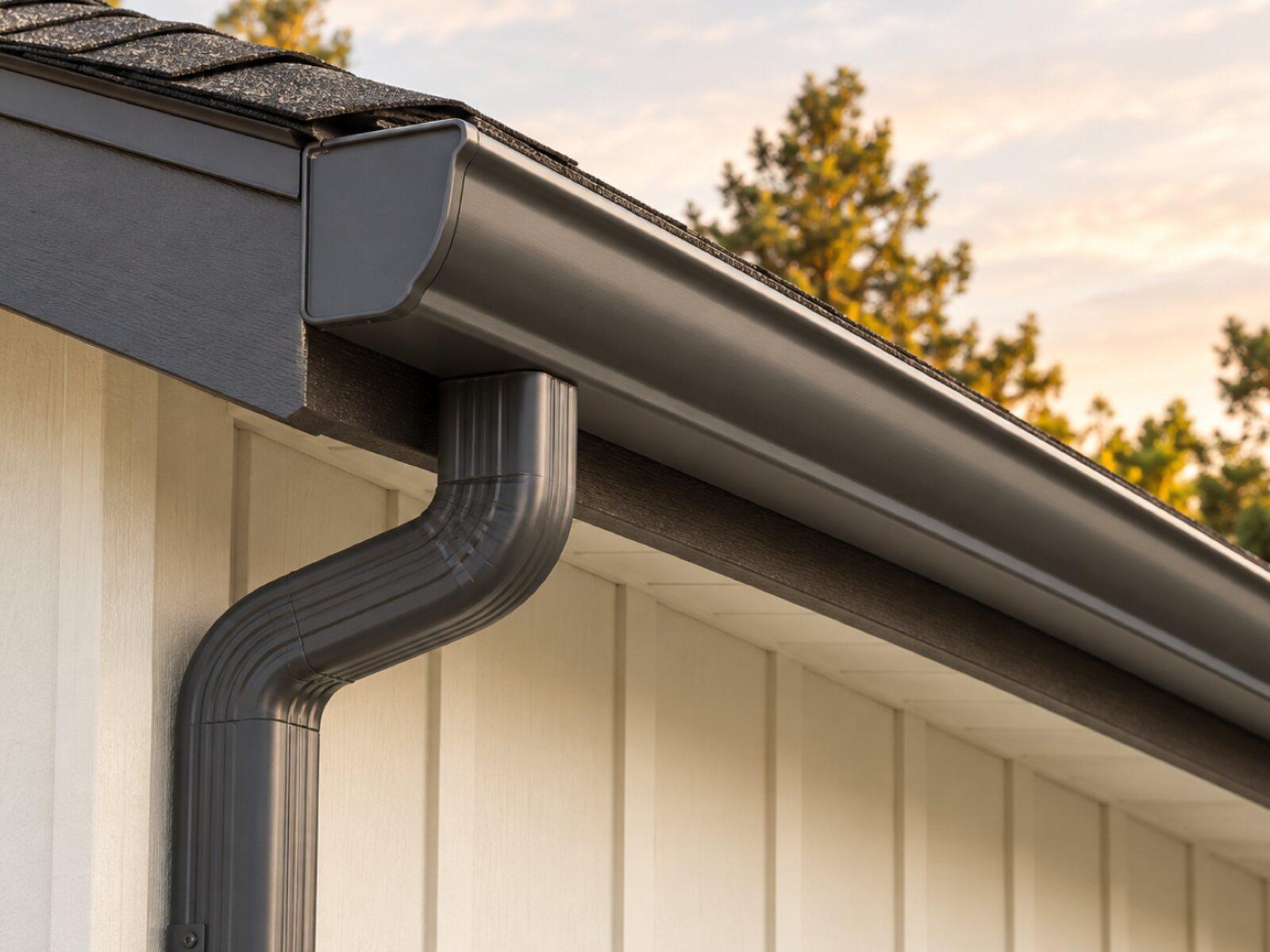
Keep a copy for your site visit or when comparing estimates.
Included in a written scope
- Removal and disposal of existing gutters and downspouts where replacement is planned
- Inspection of fascia, with repair or replacement written as its own line
- Seamless gutters formed on site, pitched to outlets, and hung on hidden hangers
- Downspouts placed for drainage, with extensions or splash blocks where water must be moved from the foundation
- Guards installed as specified, if selected
- Cleanup and removal of old material
Clarify before work starts
- How many downspouts and where each one discharges
- Whether fascia repair or painting is included
- Which guard style is quoted and how it is cleaned
- Whether underground drains are part of the scope
How a gutters project works
The stages to discuss when planning your project.
Talk through the project
Tell us what you want to repair or update. A few details about the home and what you have noticed are enough to start.
Review the home and options
A site review identifies the work involved, checks the usual trouble spots, and covers the choices that fit your home.
Agree on the scope and schedule
Review what is included, what is not, and how changes are handled before any work is scheduled.
Walk through the result
Review the completed work together, along with the applicable care and warranty information for what was installed.
Gutters questions from Sacramento homeowners
Do I need a permit to replace gutters in the City of Sacramento?
Not for a like-for-like gutter and downspout replacement. A permit from the City of Sacramento Community Development Department, Building Division comes into play only if the job uncovers structural rot, such as rafter tails or roof sheathing behind the fascia, which is a separate repair with its own line in the estimate. Connecting a downspout to a public storm drain or a curb outlet is a Department of Utilities question, not a building permit, and no public connection is made without the city's sign-off. Fascia board replacement, re-hanging, and guards need no permit.
Does my Sacramento house need 5-inch or 6-inch gutters?
Size the system from the roof areas collected, slope and concentrated runoff, together with gutter profile, outlets, downspouts and discharge capacity. A house’s floor area or neighborhood is not enough to choose five- or six-inch gutters. Have the proposal show the layout and explain any observed overflow before assuming a larger profile is the remedy.
Which gutter guard works under Sacramento's street trees?
Compare products against the debris actually reaching the roof, roof geometry and maintenance access. Leaves and fine debris can behave differently, but a tree species alone does not establish a best product. Ask how guards are attached and how the channels and outlets remain accessible for inspection. Continued maintenance should remain part of the decision.
Where should my downspouts drain in Sacramento?
Away from the foundation, and the right answer changes by neighborhood. In Downtown, East Sacramento, and Land Park many downspouts drop into old underground drains that run to the combined sewer; if yours does, it gets a water test and stays in service if it flows, and if it has collapsed the downspout is rerouted to grade rather than left feeding the soil at the wall. In Natomas the clay ponds, so downspouts get extensions to the lawn or a drain to the curb. In the Pocket and Greenhaven the lots drain to the street and outlets go to the front. Any new connection to a public storm drain goes through the city's Department of Utilities.
My 1920s Land Park house has built-in box gutters. Reline them or replace them?
Assess the liner, supporting wood, drainage and connection to the roof before comparing repair, relining and replacement. On a designated property, confirm any preservation requirements before changing the profile. The estimate should identify access and finish restoration and separate confirmed repairs from concealed-condition allowances. Neither the age nor the gutter style establishes which option costs less.
Can you trim the street tree that keeps filling my gutters?
No, and neither can you without a permit. Trees in the planting strip along Sacramento streets are generally city-maintained and fall under the City of Sacramento Urban Forestry section; pruning or removing one needs a permit from Urban Forestry, and requests or questions about a street tree go to 311. Gutter size, guard selection and cleaning access should account for the actual tree debris. Check whether a private tree is protected before arranging pruning. Tree clearance and gutter access are separate maintenance questions; neither eliminates the need to inspect and clean the drainage system.
Should I replace the gutters when I reroof my Natomas home?
Coordinate the work, but assess the gutters separately. Condition, attachment and the roof-edge detail determine whether they can remain, need temporary removal or merit replacement. Include fascia investigation where warranted and assign restoration responsibilities. A reroof on a Natomas house does not automatically mean the gutters are original or unusable.
When is the best time to install gutters in Sacramento?
Plan around actual condition, access, weather and contractor availability. Inspecting and addressing known drainage problems before wet weather can be useful, but there is no guaranteed best booking month or short lead time. The scope should include temporary drainage where gutters are removed and a plan for weather interruptions during fascia or roof-edge work.
Tell us about your Sacramento gutters project.
Share what you have noticed and what you would like to change. We'll review the details and contact you about the next step.
No budget, address, or photos needed to inquire.
Other exterior services in Sacramento
- Siding replacement for Sacramento homesExplore repair and replacement options for your home's exterior walls.
- Window & door replacement for Sacramento homesFind an updated look and a fit that works for your home.
- Roof replacement for Sacramento homesPlan the next step for a worn or damaged roof.
- Exterior painting for Sacramento homesRefresh the finish, starting with the preparation underneath.
- Dry rot & trim repair for Sacramento homesAddress damaged wood and understand the work around it.