
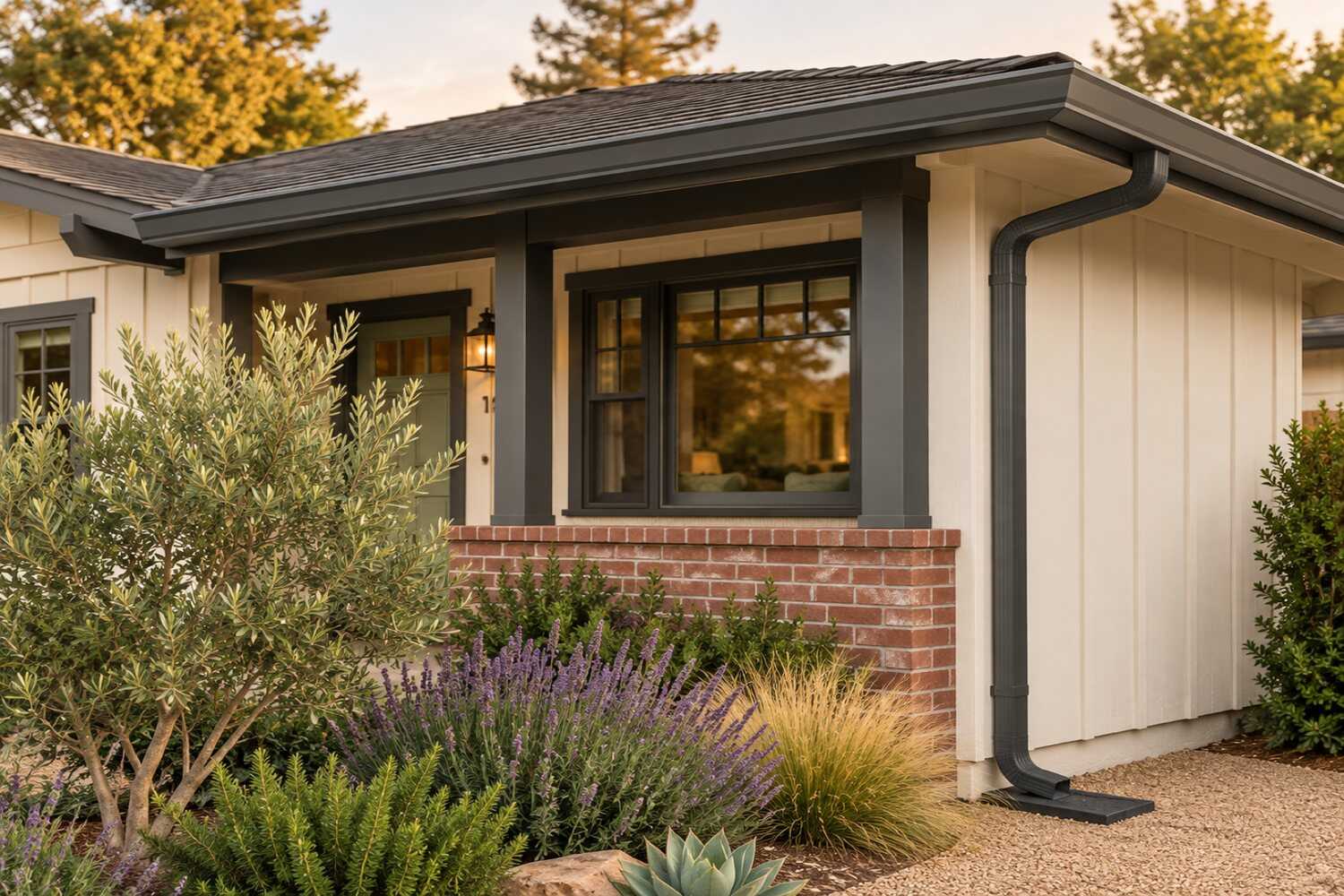
Gutter installation and replacement in Folsom, CA.
For Folsom gutters, map the roof sections, existing runs and discharge routes before pricing replacement. Inspect fascia and any buried drains, and account for slope or two-story access where present. The construction decade does not establish gutter age, missing coverage or concealed damage.
What gutter installation costs in Folsom
Published figures put gutter installation in Folsom between $118–$1,046 on homeyou's Folsom calculator and $2,600–$5,000 for a 170–240-foot city example in GutterFX's Sacramento metro guide; Sacramento Gutter Guard's larger-project tier is $4,000–$8,000 and up. Soft fascia behind the 1980s runs, crushed builder drain lines and micro-mesh guards under oak canopy move the number.
| Scope | Published range | What it usually includes |
|---|---|---|
| homeyou Folsom installation calculator | $118–$1,046 | homeyou's Folsom installation headline, which does not say whether it covers a single downspout, a short repair run or a full-perimeter job. The same page carries a wider $571–$5,272 installation statement. Neither figure comes with a footage, so pin down the quantity and the included parts before either is used for a Folsom house. |
| GutterFX Folsom city-project example | $2,600–$5,000 | GutterFX's Folsom example in its Sacramento metro guide, priced at $9–$14 per foot over roughly 170–240 linear feet. A two-story Empire Ranch or Broadstone house with hips and returns can run past that footage, and the example carries no allowance for tearing off old runs or repairing hardboard fascia, so it is a benchmark rather than a measured quote. |
| Sacramento Gutter Guard larger-project example | $4,000–$8,000+ | Sacramento Gutter Guard's regional larger-project tier, described as roughly 200–300-plus feet with harder access, which is the profile of the canyon-lot and terraced east-side homes in Folsom. Guards are a separate published option on that page, so a micro-mesh system for the oak and pine litter near Lake Natoma is added to this range, not included in it. |
Ranges are published third-party figures, not 916 Exteriors prices; the written estimate is the only number that applies to your home.
How to compare these ranges
The three published figures describe different quantities and should not be read as one repair-to-replacement ladder for Folsom. What moves the number locally is the house behind the gutter: the 1980s hardboard fascia in Lexington Hills, Willow Creek and the streets near Lake Natoma often needs repair before new hangers will hold, and the 1990s–2000s tracts in Empire Ranch and Broadstone have builder drain lines at the downspouts that are tested and cleared as a separate item.
Two-story eaves and the terraced canyon lots add staging. Guards under oak canopy are priced as an option with the product named, and a fire-zone parcel is checked with the City of Folsom before the assembly is chosen.
Bids compare only when they carry the same footage, profile, downspout routes and color.
Sources
- City of Folsom: Community Development Department (building permits and Historic District design review)
- CAL FIRE OSFM: current WUI code and local applicability
- homeyou: Gutter installation in Folsom, CA, costs
- homeyou: Gutter repair in Folsom, CA, costs
- GutterFX: Sacramento metro gutter installation cost guide, with Folsom pricing
- Sacramento Gutter Guard: Gutter installation cost in Sacramento (2026)
Read next: How much does gutter installation cost in Folsom?
What changes the price in Folsom
- Run length on the 2000s hips
- Empire Ranch, Broadstone, and the lake-side homes carry 170 to 240-plus feet of eave, and the long runs on steep tile roofs usually need a 6-inch profile and an added outlet.
- Fascia behind the 1980s gutters
- Hardboard and finger-joint fascia in Lexington Hills, Willow Creek Estates, and the canyon is soft behind most of the original runs and is replaced by the foot before anything is hung.
- Two-story and hillside eaves
- Canyon lots with the downhill eave two stories up and the two-story tracts need staging or a lift, which adds a day.
- Buried drain lines in the stucco tracts
- The 1990s–2000s builder drains to the curb have crushed or filled with roots; testing, clearing, or replacing them is its own line and can cost as much as the gutters.
- Guards under the oak and pine canopy
- Micro-mesh is the guard that works under the live oaks and gray pine on the north side, and it costs more per foot than the screens that suffice on the open tracts.
- HOA color and submittal
- Empire Ranch, Broadstone, and Folsom Ranch review gutter color against the approved fascia and trim, and adding gutters where none existed may take a submittal.
- Fire hazard zone materials
- Parcels along Folsom Lake and the American River canyon are quoted in metal with debris-excluding guards and ember-resistant vents, which costs more than a like-for-like aluminum replacement.
Compare gutters and guards
Choose two options to compare the upkeep, fit and installation details.
| Compare | Seamless aluminum gutters | Steel or copper gutters |
|---|---|---|
| Appearance | Continuous runs; many baked-on colors | Heavier profile; copper weathers to a patina |
| Maintenance | Cleaning; check outlets and hangers | Similar cleaning; copper needs compatible fasteners |
| Where it fits | Most homes; 5-inch or 6-inch profile sized to the roof | Design-led homes or heavy-debris settings |
| Installation | Formed on site to exact length; hidden hangers | Higher material cost; specialty fabrication |
View all 5 options and planning notes
Seamless aluminum, formed on site to the exact run length, is the standard replacement gutter in the region and the best value; steel and copper cost more and suit specific homes. Among guards, micro-mesh keeps out needles and seeds and is the usual choice under oak and pine, perforated screens are cheapest and pass small debris, and reverse-curve hoods can overshoot in the heavy winter storms that Sacramento gets.
| Option | Appearance | Maintenance | Where it fits | Installation notes |
|---|---|---|---|---|
| Seamless aluminum gutters | Continuous runs; many baked-on colors | Cleaning; check outlets and hangers | Most homes; 5-inch or 6-inch profile sized to the roof | Formed on site to exact length; hidden hangers |
| Steel or copper gutters | Heavier profile; copper weathers to a patina | Similar cleaning; copper needs compatible fasteners | Design-led homes or heavy-debris settings | Higher material cost; specialty fabrication |
| Micro-mesh guards | Low-profile screen that follows the gutter | Occasional brushing; fine debris can film the mesh | Trees with needles, seeds, and small leaves | Fastened to the gutter and tucked under shingles or to fascia |
| Perforated or screen guards | Visible panel over the gutter | Larger openings pass small debris; periodic clearing | Broad-leaf trees | Simplest to install and remove |
| Reverse-curve guards | Solid hood with a slot at the front | Can overshoot in heavy rain; slot needs clearing | Moderate debris, gentler roof pitches | Usually tied to the roof edge; check roofing warranty terms |
Guard performance depends on the trees over the roof and the roof pitch; no guard makes a gutter maintenance-free.
Planning gutters work in Folsom
Open the topics that apply to your property.
Gutters in Folsom differ from the neighbors in what is behind them and below them. Fair Oaks and Orangevale, unincorporated Sacramento County to the west, are 1970s–80s houses under full oak canopy, where the fascia is usually sound and the job is a guard choice against the leaf load. Granite Bay, across the Placer County line, is large-lot housing where the runs are long and the discharge goes to a slope or a swale, not a curb. Folsom's 1980s hardboard fascia, its builder drain lines to the curb in the 1990s tracts, and its terraced east-side lots turn the same gutter job into three different scopes.
Compare nearby: Gutter installation for El Dorado Hills homes · Gutter installation for Rancho Cordova homes · Gutter installation for Granite Bay homes
Gutter installation for Folsom homes
Folsom's gutter work follows the roof type and the decade. The 1970s–80s wood-sided houses north of Highway 50, a quarter of the city's stock, have original aluminum or galvanized sectional gutters spiked into hardboard fascia that has been wet for forty years. The 1990s–2000s tile-roofed tracts south of the freeway (Broadstone, Natoma Station, Empire Ranch) got builder-minimum runs over the front door and the patio slider, with downspouts tied into buried drain lines to the curb. Folsom Ranch, since the 2010s, has full-perimeter gutters that mostly need cleaning.
What crews find: on the 1980s houses, the gutter pulls away because the spikes are in rotten fascia, and the sub-fascia and rafter tails behind it are often soft too. The gutters go up last, after the wood. On the tile tracts, the partial runs mean half the roof sheds onto the stucco and the planters. The buried drains have crushed or filled with roots, so the downspouts back up in the first big storm. On the hillside lots east and north, the discharge has nowhere to go but the neighbor's yard unless it is routed.
A Folsom gutter estimate should measure every run, count corners and outlets, size the profile to the roof area feeding it (the long tile hips need 6-inch), and show where each downspout discharges. Fascia repair should be priced per foot before anything is hung, and buried drains tested and priced as their own line. The gutter service page and the guard comparison cover the product choices. The Folsom adders are fascia rot, crushed builder drains, micro-mesh under the oaks and the fire-zone assembly on canyon lots.
Housing age and what to inspect
Housing age helps plan an inspection. The share of homes in each decade is census data; the notes describe materials and conditions to check at the property.
| Built | Share of homes |
|---|---|
| Before 1940 | 1% |
| 1950–1959 | 3% |
| 1960–1969 | 2% |
| 1970–1979 | 6% |
| 1980–1989 | 19% |
| 1990–1999 | 27% |
| 2000–2009 | 26% |
| 2010 and later | 15% |
Folsom: 30,868 housing units, median year built 1997, median owner-occupied value $755,200, 70% owner-occupied. Source: U.S. Census Bureau, American Community Survey 2020–2024 5-Year Estimates, tables B25034 (year structure built), B25035 (median year built), B25077 (median value, owner-occupied), B01003, B25003 (ACS 2024 5-year).
- Historic Folsom and prewar homes1850s–1930s (about 1% of homes)
- The oldest houses in Historic Folsom have steep roofs, small eaves and sometimes a half-round gutter on ornamental brackets, or no gutter at all. Water from those roofs lands close to the foundation, and the porch roofs shed onto the steps. A new gutter has to fit the fascia profile and the porch, and a visible change on a street-facing eave may fall under the City's Historic District design review. Half-round in the same metal is the usual answer, and the estimate should show where each downspout can lawfully discharge on a small lot.
- Postwar housing1950s–1960s (about 5% of homes)
- Wide eaves and low-slope roofs mark the 1950s–60s ranches around Natoma Street and Riley Street, often still with the original galvanized gutters rusted through at the seams. The fascia is 2x redwood or fir and usually sound. The job is a straight K-style replacement with new hangers into solid wood, and the main question is discharge, because the lots are flat and the yards drain slowly. A splash block is not a plan. The estimate should show where the water goes.
- 1970s and 1980s1970s–1980s (about 25% of homes)
- The 1970s–80s houses north of the freeway (Lexington Hills, Willow Creek Estates, the streets off Folsom-Auburn Road) are where Folsom's fascia rot lives. The original aluminum gutters were spiked into finger-joint or hardboard fascia, the spikes let go, the gutter tilts back against the wall, and forty winters of overflow have soaked the sub-fascia and rafter tails. Crews replace the fascia by the foot first, sometimes the rafter tails, then hang new gutters on hidden hangers into solid wood. The estimate should carry fascia and rafter-tail repair as priced lines, and the rafter tails may need a permit.
- 1990s1990s (about 27% of homes)
- Builder-minimum gutters went onto the 1990s tracts (Broadstone, Natoma Station, Briggs Ranch and early Empire Ranch). That means a run over the front door, a run over the patio slider, and a tile roof shedding everywhere else onto the stucco and the planters. The downspouts drop into buried lines that run to the curb, and thirty years on those lines have crushed under driveways or filled with roots. A gutter job here is adding the missing runs, sizing them for the tile hips, and testing the buried drains before reconnecting. The drain repair can cost as much as the gutters.
- 2000 and later2000s–2020s (about 41% of homes)
- Full-perimeter aluminum gutters on 2x fascia are standard on the homes built since 2000 (later Empire Ranch, Parkway and Folsom Ranch), with buried drains or splash blocks. Most of the work is maintenance, resizing a run that overflows at an inside corner, or adding a guard. The steep hips concentrate water at a few outlets, so an added downspout often fixes an overflow that a wider gutter would not. In the HOA tracts, a color change or a visible guard may need a submittal. Confirm where the buried drains daylight before reconnecting to them.
Gutters by neighborhood in Folsom
- Lexington Hills
- Lexington Hills is the 1980s tract where the fascia behind the gutters is most often soft, and its hillside lots put the downhill eave two stories up. Replace the fascia by the foot, then hang the gutters on hidden hangers. Downspouts on the downhill side need a route that does not send water to the house below.
- American River Canyon
- American River Canyon's homes sit on the bluffs over Lake Natoma, with gray pine and oak dropping needles and leaves into the gutters year-round, and parts of these lots are in mapped fire hazard zones. A metal system with a debris-excluding guard and ember-resistant eave vents may be required there. Confirm the parcel with the City. Discharge runs to a slope, so route it.
- Willow Creek Estates
- Willow Creek Estates, built around 1990, has some of the heaviest tree canopy north of the freeway: the redwoods and oaks kept or planted then now overhang the roofs. Guards are a maintenance decision there, not a luxury. Micro-mesh handles the fine litter. Check the fascia wherever the gutters have overflowed under the trees.
- Natoma Station
- Natoma Station's 1990s houses have partial builder runs and downspouts into buried drains to the curb, and the drains are the first thing to test. A backed-up downspout in the first storm means a crushed or rooted line, priced as its own repair. Add the missing runs sized for the tile hips.
- Broadstone and Empire Ranch
- Broadstone and Empire Ranch have the long, steep tile hips that overwhelm a 5-inch gutter at the inside corners, and both HOAs review gutter color against the fascia. Size the runs at 6-inch where the hips concentrate flow, add an outlet at each overflow point, and test the buried drains. A same-color replacement is usually a routine notice.
- Folsom Ranch
- Built since the 2010s, Folsom Ranch's homes have full-perimeter gutters and are mostly a cleaning and guard question, with the occasional overflow at an inside corner on a two-story. The HOA reviews color and visible guards. Check whether the builder's buried drains carry the water clear of the slab, and where they daylight.
Sun, rain, trees and site conditions
Folsom is in climate zone 12, and gutters here do almost nothing for nine months and everything for three. Nearly all of the rain arrives between November and March, often in a few atmospheric-river storms that drop most of the season's water in a few days. A tile hip on a Broadstone two-story sends that at one inside corner all at once. Gutters are sized for that hour, not the annual average: 6-inch profiles on the long tile runs, an extra outlet at each concentration point, and downspouts that can carry it.
Trees set the maintenance load and the guard choice. Interior live oak drops small leaves year-round, valley oak drops leaves and acorns in fall, cottonwoods along Lake Natoma shed cotton in spring, and gray pine along the canyon drops needles that slip through a screen. The 1980s tracts also planted redwoods that now overhang the eaves. Under that mix, micro-mesh is the guard that works, and it still needs a brushing when pollen films it. On the open tracts south of the freeway a screen is enough.
Terrain decides where the water goes. The historic core and the postwar streets are flat and drain slowly. The east and north sides are terraced hillsides on thin, rocky soil, where a downspout dumped at a footing runs along the foundation to the neighbor's retaining wall. The 1990s–2000s tracts solved this with buried drains to the curb, and those lines are now the weak point. Along Lake Natoma and the American River canyon, parts of Folsom sit in mapped fire hazard severity zones, where the current wildland-urban interface code may govern the gutter material, guards and eave vents at replacement. Check the parcel with the City before ordering.
Permits and approvals
Gutter replacement does not usually need a building permit from the City of Folsom Community Development Department, Building Division, and neither does adding gutters to a house that never had them. The permit question comes up when the work becomes structural: rotted rafter tails, sub-fascia, or eave sheathing found behind the old gutter, which on the 1980s hardboard homes happens often enough that the estimate states who pulls the permit if it becomes necessary and how the inspection is scheduled. The licensed contractor should sign it, not the homeowner. Confirm current requirements with the Building Division rather than assuming a fee or turnaround.
HOA architectural review in Empire Ranch, Broadstone, Folsom Ranch, and many of the smaller tracts off Blue Ravine and Iron Point covers exterior color and visible material. Replacing gutters in the same color as the fascia is usually a routine notice or no submittal at all. Adding gutters to a house that had partial runs, or changing to a contrasting color, copper, or a visible guard, can be a submittal. The estimate includes the product and color sheet the committee will ask for. In the Historic District, a visible change on a street-facing eave can fall under the City of Folsom's Historic District design review through the Community Development Department. A same-profile, same-metal replacement is the simpler case, and listed historic resources draw closer review. Confirm the address with the City before a new profile is ordered.
On parcels inside the mapped fire hazard zones along the American River canyon, Lake Natoma and the open-space edges of the east-side tracts, the California wildland-urban interface code can reach gutters and eave vents when they are replaced; confirm with the City of Folsom whether local fire-code amendments apply to the parcel before a gutter profile or vent is ordered. SMUD serves Folsom, and the service mast on the older homes often comes through the eave; a gutter run is routed around it with the working clearance kept, and the estimate says so. Downspouts tied into the buried drain lines in the 1990s–2000s tracts feed the lot's storm drainage, so the estimate states whether those lines were tested and whether clearing them is included or priced separately.
Permit authority: City of Folsom Building Services . Whether a permit or review applies, and who pulls it, is written into the estimate.
Seeing something on your own house? Request an estimate for gutters in Folsom
Repair, reseal, or replace?
Gutters fail at seams, hangers, and outlets before the runs themselves wear out. The fix depends on where the problem is.
Not sure which applies? Tell us what you are seeing and request an estimate for gutters.
What the scope includes
A complete estimate names the work, materials and exclusions so you can compare proposals.
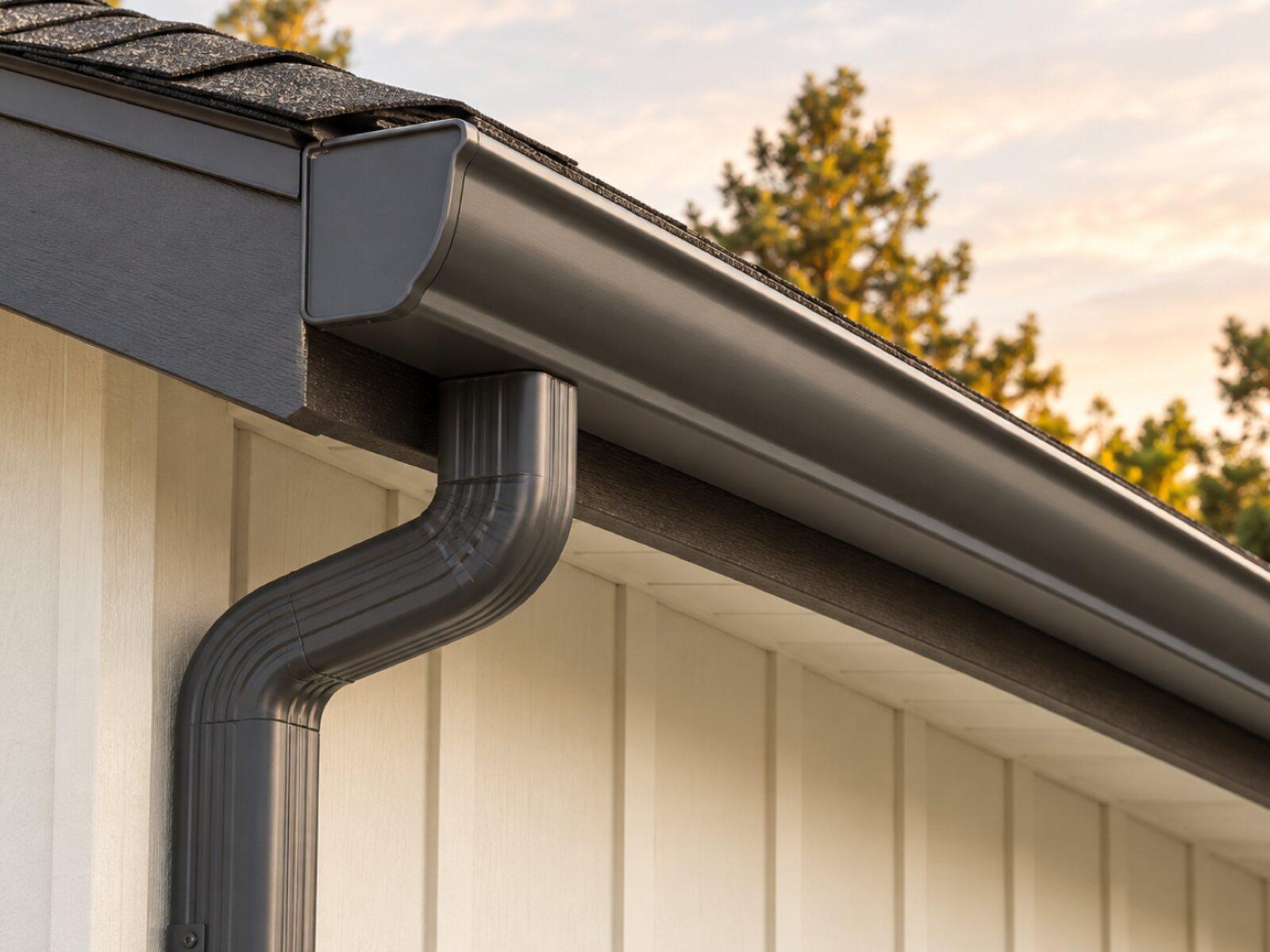
Keep a copy for your site visit or when comparing estimates.
Included in a written scope
- Removal and disposal of existing gutters and downspouts where replacement is planned
- Inspection of fascia, with repair or replacement written as its own line
- Seamless gutters formed on site, pitched to outlets, and hung on hidden hangers
- Downspouts placed for drainage, with extensions or splash blocks where water must be moved from the foundation
- Guards installed as specified, if selected
- Cleanup and removal of old material
Clarify before work starts
- How many downspouts and where each one discharges
- Whether fascia repair or painting is included
- Which guard style is quoted and how it is cleaned
- Whether underground drains are part of the scope
How a gutters project works
The stages to discuss when planning your project.
Talk through the project
Tell us what you want to repair or update. A few details about the home and what you have noticed are enough to start.
Review the home and options
A site review identifies the work involved, checks the usual trouble spots, and covers the choices that fit your home.
Agree on the scope and schedule
Review what is included, what is not, and how changes are handled before any work is scheduled.
Walk through the result
Review the completed work together, along with the applicable care and warranty information for what was installed.
Gutters questions from Folsom homeowners
My Broadstone house only has gutters over the front door and the patio slider. Is that normal, and should I add the rest?
It is normal for Broadstone and the other 1990s Folsom tracts; production builders installed gutters only where runoff would land on a walkway or doorway and left the rest of the eave to shed onto the ground. Whether to add the rest depends on where the water goes now: splash staining on the stucco, erosion at the foundation, a wet crawlspace or ponding against a slab are the reasons to extend. Map the roof sections, size the runs and outlets for them, and give every new downspout a workable destination, since collecting water with nowhere to send it is the common mistake.
Do I need a permit from the City of Folsom to replace or add gutters?
Ask the City of Folsom Community Development Department, Building Division about the actual scope rather than assuming an exemption. A same-for-same gutter swap is generally maintenance, but the question changes when the job adds runs that alter where water discharges, ties into the lot's storm drainage, or turns into structural repair of rafter tails, sub-fascia or eave sheathing found behind the old gutter, which on Folsom's 1980s hardboard homes is common. HOA review in Empire Ranch or Broadstone and Historic District design review near Sutter Street are separate approvals. The estimate should assign each one and any inspection to a named party.
Which gutter guard works under the oaks in Willow Creek Estates or near Lake Natoma?
Micro-mesh. The interior live oaks drop small leaves year-round, the valley oaks drop acorns and leaves in fall, the cottonwoods along the lake drop cotton in spring, and the gray pine on the canyon drops needles; a screen guard passes the small leaves and needles, and a reverse-curve hood overshoots in the heavy winter storms on a steep roof. Micro-mesh keeps all of it out and needs an occasional brushing where pollen films the mesh. It costs more per foot, and the estimate names the guard, the trees it is chosen for, and the maintenance it still needs.
The gutters on my 1980s Lexington Hills house are pulling away from the fascia. Can they be re-hung?
Sometimes, and the fascia decides. Spike-and-ferrule hangers on a 1980s Lexington Hills house pull out of hardboard fascia once the board has swollen or softened, and driving new spikes into the same board does not hold. If the fascia is still sound, the run can be re-hung on hidden hangers screwed into the rafter tails. If a probe finds soft board, the fascia is repaired or replaced first and the gutter goes back on afterward, with any roof-edge and paint restoration listed separately. Pulling away is a symptom with several causes, so the estimate should state which one it found.
The builder's underground drains in Empire Ranch are backing up at the downspouts. Is that part of a gutter job?
Only if the contract says so. The buried lines that builders ran from the downspouts to the curb in Empire Ranch and the other 1990s–2000s tracts are a drainage system, not part of the gutter, and they crush, silt up and fill with roots at about the age the gutters need replacing. A gutter installer can test them, clear them with a jetter or reroute the downspout to a splash block, but each is a separate line item and some of that work belongs with a drainage or plumbing contractor. New gutters will not push water through a blocked pipe, so confirm the destination before reconnecting.
My house backs onto the American River canyon. Does the fire zone change what gutters I can install?
It can. Homes along the American River canyon and around Lake Natoma may sit inside mapped fire hazard zones, where the California wildland-urban interface code can reach the gutter, the eave and the vents when they are replaced. CAL FIRE's home-hardening guidance recommends a noncombustible gutter with a cover that keeps needles and leaves off the roof edge. Whether the code applies to a replacement on an existing home is decided by the parcel and the City of Folsom, including any local fire-code amendments. The estimate should name the assembly it prices to and the approving authority, with voluntary hardening as a priced option.
Tell us about your Folsom gutters project.
Share what you have noticed and what you would like to change. We'll review the details and contact you about the next step.
No budget, address, or photos needed to inquire.
Other exterior services in Folsom
- Siding replacement for Folsom homesExplore repair and replacement options for your home's exterior walls.
- Window & door replacement for Folsom homesFind an updated look and a fit that works for your home.
- Roof replacement for Folsom homesPlan the next step for a worn or damaged roof.
- Exterior painting for Folsom homesRefresh the finish, starting with the preparation underneath.
- Dry rot & trim repair for Folsom homesAddress damaged wood and understand the work around it.