
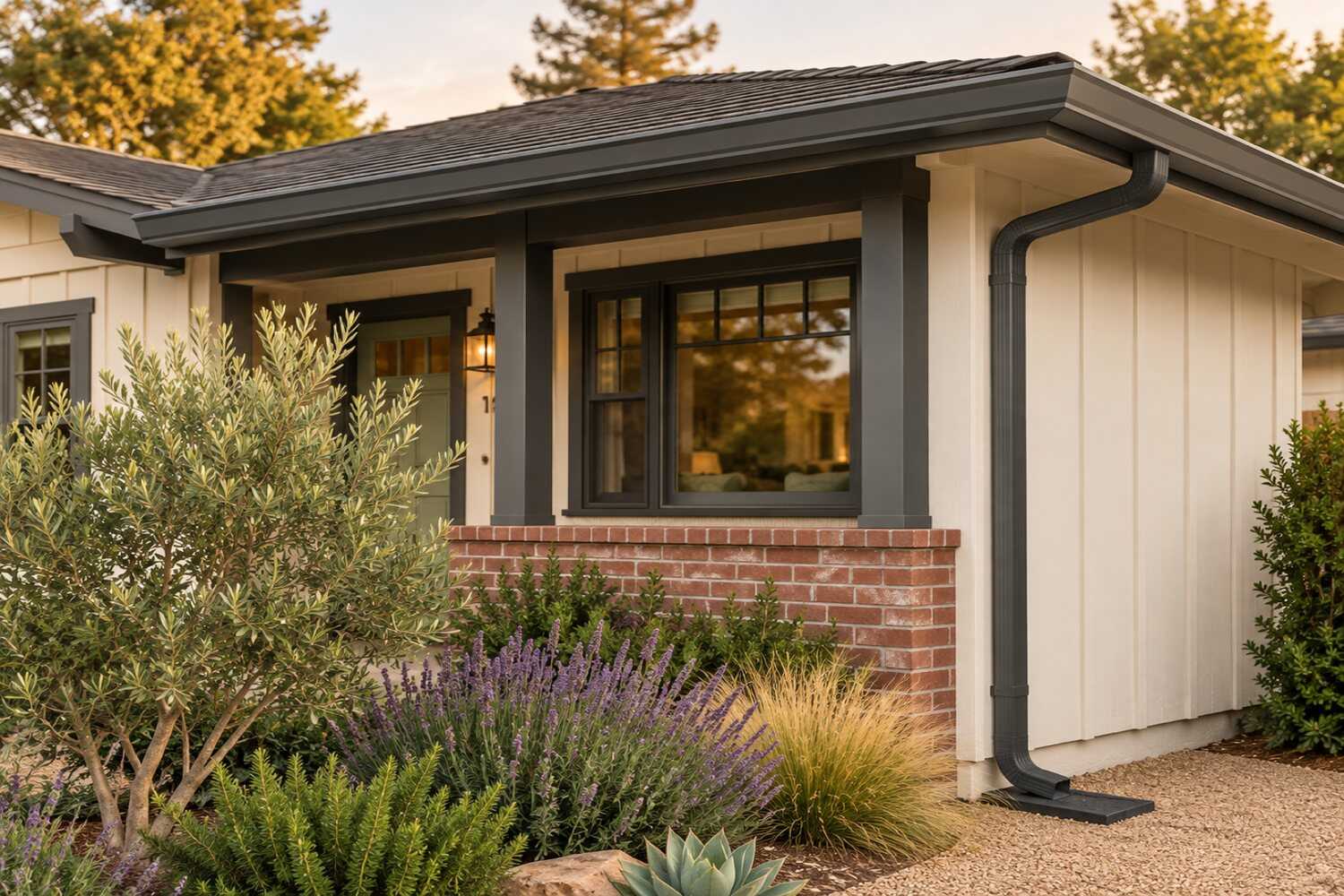
Gutter installation and gutter guards in Roseville, CA.
For Roseville gutters, trace rainwater from each roof section to its discharge point. Measure the channels and outlets, inspect supporting fascia, and account for two-story access where present. Roof material and neighborhood age alone do not establish that the existing gutters are undersized.
What gutter installation costs in Roseville
Published 2026 figures put gutter installation in Roseville between about $113–$1,002 for a short run or repair (homeyou) and $2,400–$4,800 for a 160–220-foot city example at $9–$14 per foot (GutterFX). Sacramento Gutter Guard's larger-project tier runs $4,000–$8,000-plus. Two-story tile eaves, underground drain connections and guards under oaks move the number.
| Scope | Published range | What it usually includes |
|---|---|---|
| homeyou Roseville installation calculator | $113–$1,002 | homeyou’s installation headline for Roseville, a figure that reads like a short run, a repair or a single downspout without saying which. The page also gives a broader $571–$5,272 installation statement; for a single-story Sun City Roseville home, ask which quantity either figure describes before using it. |
| GutterFX Roseville city-project example | $2,400–$4,800 | GutterFX’s Roseville example uses about 160–220 linear feet at $9–$14 per foot, roughly a one-story tract home’s full perimeter. A two-story in Westpark or Highland Reserve has similar footage at a higher eave, so the layout, downspout count, tear-off and fascia allowances have to be written out; the published total is a model, not a measured quote. |
| Sacramento Gutter Guard larger-project example | $4,000–$8,000+ | Sacramento Gutter Guard’s regional premium tier covers roughly 200–300-plus feet and harder access, the kind of footage a larger two-story with a tile edge carries. Guards are priced separately in that guide, so a micro-mesh system is an added line, not something bundled into this range. |
Ranges are published third-party figures, not 916 Exteriors prices; the written estimate is the only number that applies to your home.
How to compare these ranges
The Roseville calculator and the two contractor guides describe different quantities, so they do not stack into a repair-to-replacement ladder. What moves a Roseville gutter number is footage and height: a two-story tile roof in Westpark or Fiddyment Farm puts the crew on a steeper edge and adds staging, while the older east-side homes near Cirby Way often need fascia repair before new hangers will hold, and that carpentry is its own line.
Downspout routing is the other variable, because a flat west-side lot usually drains to a buried line at the curb core, and testing or replacing that line is separate from the gutters above it. Guards are quoted as an option with the product named, and any parcel-specific wildfire assembly requirement is confirmed with the Building Inspection Division.
Compare bids on the same footage, profile, discharge route and color.
Sources
- CAL FIRE OSFM: current WUI code and local applicability
- City of Roseville Building Inspection Division: Permit exemptions list (effective January 1, 2026)
- City of Roseville Engineering – Land Development: Encroachment permits (RMC 13.28.010)
- GutterFX: Sacramento metro gutter installation cost guide (Roseville, Rocklin, Folsom)
- Sacramento Gutter Guard: Gutter installation cost Sacramento 2026
- homeyou: Gutter installation in Roseville, CA, costs
Read next: How much does gutter installation cost in Roseville?
What changes the price in Roseville
- Two-story eaves
- Most 1990s and 2000s Roseville homes need ladder staging or a lift for the upper runs, which sets the labor rate per foot.
- Tile roof edge details
- Setting the gutter under a tile eave with the bird stop and drip edge, and fitting guards that do not lift the tile, takes longer than a shingle edge.
- Downspout count and routing
- Adding outlets for the tile's concentrated flow and running upper-roof downspouts to grade or into the underground drains adds parts and labor.
- Fascia condition on the east side
- Rotted fascia behind 1970s sectional gutters is repaired or replaced before anything is hung, priced per foot.
- Guards under oaks and redwoods
- Micro-mesh on the shaded runs in Diamond Oaks, Johnson Ranch, and downtown adds a per-foot cost that screens do not.
- HOA color
- A gutter color other than the builder's in Westpark or Fiddyment Farm can mean an application and a custom color run.
Compare gutters and guards
Choose two options to compare the upkeep, fit and installation details.
| Compare | Seamless aluminum gutters | Steel or copper gutters |
|---|---|---|
| Appearance | Continuous runs; many baked-on colors | Heavier profile; copper weathers to a patina |
| Maintenance | Cleaning; check outlets and hangers | Similar cleaning; copper needs compatible fasteners |
| Where it fits | Most homes; 5-inch or 6-inch profile sized to the roof | Design-led homes or heavy-debris settings |
| Installation | Formed on site to exact length; hidden hangers | Higher material cost; specialty fabrication |
View all 5 options and planning notes
Seamless aluminum, formed on site to the exact run length, is the standard replacement gutter in the region and the best value; steel and copper cost more and suit specific homes. Among guards, micro-mesh keeps out needles and seeds and is the usual choice under oak and pine, perforated screens are cheapest and pass small debris, and reverse-curve hoods can overshoot in the heavy winter storms that Sacramento gets.
| Option | Appearance | Maintenance | Where it fits | Installation notes |
|---|---|---|---|---|
| Seamless aluminum gutters | Continuous runs; many baked-on colors | Cleaning; check outlets and hangers | Most homes; 5-inch or 6-inch profile sized to the roof | Formed on site to exact length; hidden hangers |
| Steel or copper gutters | Heavier profile; copper weathers to a patina | Similar cleaning; copper needs compatible fasteners | Design-led homes or heavy-debris settings | Higher material cost; specialty fabrication |
| Micro-mesh guards | Low-profile screen that follows the gutter | Occasional brushing; fine debris can film the mesh | Trees with needles, seeds, and small leaves | Fastened to the gutter and tucked under shingles or to fascia |
| Perforated or screen guards | Visible panel over the gutter | Larger openings pass small debris; periodic clearing | Broad-leaf trees | Simplest to install and remove |
| Reverse-curve guards | Solid hood with a slot at the front | Can overshoot in heavy rain; slot needs clearing | Moderate debris, gentler roof pitches | Usually tied to the roof edge; check roofing warranty terms |
Guard performance depends on the trees over the roof and the roof pitch; no guard makes a gutter maintenance-free.
Planning gutters work in Roseville
Open the topics that apply to your property.
Gutter work in Roseville is a different job from Rocklin, Granite Bay or Citrus Heights. Rocklin's tile tracts are the same age, but its Whitney Oaks and Clover Valley lots slope on granite. Downspouts there discharge to grade and daylight instead of into Roseville's flat-lot underground drains to a curb core. Granite Bay is unincorporated Placer County with a 1987 median year and acre lots under heavy oak canopy where downspouts run to grade. Guards there are about oak litter, not tile flow. Citrus Heights, in climate zone 12, is 40% 1970s single-story stock with sectional gutters on shingle eaves. In Roseville that is the small east-side minority beside a two-story tile majority.
Compare nearby: Gutter installation in Rocklin, CA · Gutter installation in Granite Bay, CA · Gutter installation in Citrus Heights, CA
Gutter installation for Roseville homes
Gutters in Roseville hang mostly on two-story tile roofs. The city's housing is 69% post-1990 (U.S. Census Bureau, ACS 2020–2024). The concrete tile on Johnson Ranch, Stoneridge, Highland Reserve, Sun City Roseville, Westpark and Fiddyment Farm sends water off the eave in a sheet and concentrates it at every valley. The original 5-inch gutters and 2×3 downspouts are undersized at those valley corners. The tile's bird-stop and eave riser also make the gutter harder to set and re-pitch than on a shingle roof.
The second Roseville detail is the underground drain. The 1990s-and-later tracts run downspouts into buried 3- or 4-inch lines that discharge through a curb core at the street. Those lines crush, root in and silt up. A gutter that overflows at one corner in December often has a blocked line under it, not a bad gutter. Test the lines before replacing the roof edge, and put the drain work on its own line in the estimate. The gutter service scope lists what a run-by-run layout should show.
East of I-80, the 1960s–70s ranches around Diamond Oaks, Sierra Gardens and Cirby Way carry sectional aluminum or steel gutters on spike-and-ferrule hangers. The fascia behind them is often soft. Those lots sit near Dry Creek, Linda Creek and Cirby Creek, inside or next to the city's mapped floodplain, and the valley oaks over them fill the gutters every fall. Inspect the fascia before new hangers go in. Decide on guards for the shaded runs with the guard comparison in hand.
Replacing gutters needs no building permit from the City of Roseville. Structural fascia or rafter-tail repair does, and a new drain line to the curb involves the city's engineering standards. Gutter color is an architectural change in the west-side associations. On the older east-side homes with overhead service, Roseville Electric's drop lands at or near the eave, so the crew works that run with clearance.
Housing age and what to inspect
Housing age helps plan an inspection. The share of homes in each decade is census data; the notes describe materials and conditions to check at the property.
| Built | Share of homes |
|---|---|
| Before 1940 | 2% |
| 1940–1949 | 1% |
| 1950–1959 | 3% |
| 1960–1969 | 4% |
| 1970–1979 | 7% |
| 1980–1989 | 14% |
| 1990–1999 | 23% |
| 2000–2009 | 25% |
| 2010 and later | 21% |
Roseville: 61,242 housing units, median year built 1998, median owner-occupied value $661,400, 69% owner-occupied. Source: U.S. Census Bureau, American Community Survey 2020–2024 5-Year Estimates, tables B25034 (year structure built), B25035 (median year built), B25077 (median value, owner-occupied), B01003, B25003 (ACS 2024 5-year).
- Prewar through the 1950sbefore 1960
- Only about 6% of Roseville's homes were built before 1960, chiefly the railroad-era bungalows around Historic Old Town and near the Union Pacific yard. Crews find half-round or ogee gutters on steep gable roofs, and sometimes built-in box gutters behind a crown molding. The fascia under them has been repainted for a century. Replace like for like where the profile is visible from the street, and inspect the rafter tails behind the fascia. Route the downspouts to a splash block or a new drain instead of onto the foundation. The Downtown Code's guidelines may apply to a visible profile change.
- 1960s and 1970s1960–1979
- Wide eaves and open rafter tails on low-slope hips: that is the 1960s–70s ranch stock in Diamond Oaks, Sierra Gardens and off Cirby Way, about 11% of the housing. Their sectional gutters hang on spikes through a 2× fascia that is often soft behind the gutter. New continuous-run 5-inch K-style on hidden hangers is the standard replacement. The estimate should include fascia repair per foot and a look at the rafter tails while the gutter is down. Oak litter over these tracts makes the guard question a real one.
- 1980s1980–1989
- Two-story plans and the first concrete tile arrived with the 1980s tracts in Cirby Ranch, the Maidu area and early Johnson Ranch, about 14% of the housing, along with upper roofs that discharge onto lower roofs. Water from an upper downspout that lands on a lower roof overloads the gutter below at the corner. Scope a downspout extension across the lower roof to its own outlet. Check the lower-roof gutter for the concentrated flow before adding capacity.
- 1990s and 2000s1990–2009
- The 1990–2009 tracts, about 48% of the city, include Johnson Ranch, Stoneridge, Highland Reserve, Woodcreek Oaks, Sun City Roseville and the first Westpark phases. Two-story concrete-tile roofs with multiple valleys are the rule, with 5-inch gutters and downspouts into underground drains that discharge at the curb. Overflow at a valley corner means an undersized outlet or a blocked line, not a bad gutter. Test the buried lines and add outlets at the valleys. Price a 6-inch gutter on the longest runs where the tile flow justifies it.
- 2010s onward2010–present
- The newest fifth of Roseville, about 21% built in 2010 or later, sits mainly in Westpark, Fiddyment Farm and the newer West Roseville villages. Their gutters are young and the calls are about performance. A corner overflows in the first big storm, a downspout drains onto the neighbor's side yard, or a homeowner wants guards instead of a two-story ladder. Check the underground drain to the curb first, then the outlet count at the valleys. The village HOA reviews a gutter color change.
Gutters by neighborhood in Roseville
- Westpark and Fiddyment Farm
- Flat former farmland, two-story tile roofs and downspouts into underground drains define Westpark and Fiddyment Farm, the West Roseville Specific Plan villages built since 2005. Each line ends at a curb core at the street. A corner that overflows in the first December storm usually means a silted line, not a gutter problem. Test the line to the curb before replacing the roof edge. Get the village HOA's approval for any color other than the builder's.
- Sun City Roseville
- Ground-level access and short runs set the gutter job in Sun City Roseville, Del Webb's age-restricted community of single-story concrete-tile roofs built after the 1993 specific plan. The valleys still concentrate flow, and the mid-1990s underground drains are at the age where they silt. Guards are the common request here because many owners no longer want to clean gutters themselves. Specify the product and its maintenance access, and check the community association's rules on color.
- Johnson Ranch and Stoneridge
- No tracts in the city have more valleys per house than Johnson Ranch, built in the late 1980s and 1990s, and Stoneridge, built in the 2000s, both east of I-80. Upper roofs discharge onto lower ones. The overflow corners are predictable: below a valley, on the west side. Add outlets at the valleys and extend upper downspouts across the lower roof. Price the two-story runs with a lift where the side yard is too tight for a ladder.
- Diamond Oaks
- The gutters in Diamond Oaks fill from October through December under the mature valley oaks that shade this 1960s–70s ranch tract around the city's golf course. Its sectional gutters hang on spikes through fascia that is soft in the shaded runs. Replace with continuous-run K-style on hidden hangers and repair the fascia by the foot. Put micro-mesh guards on the oak-shaded runs where a screen would clog in a week.
- Sierra Gardens and Cirby Way
- Flat ground near Cirby Creek and Linda Creek, inside or beside the city's mapped floodplain, sets the gutter job in Sierra Gardens and the 1960s–70s tracts along Cirby Way. Where the downspouts discharge matters as much as the gutter itself. Keep discharge off the foundation and off the neighbor's lot. Check the fascia behind the old sectional gutters before hanging anything new.
- Historic Old Town
- Steep gable roofs with half-round or ogee gutters define Historic Old Town and the bungalow blocks in the Downtown Specific Plan area. Some homes keep built-in box gutters behind the crown. Match the visible profile, inspect the rafter tails behind a century-old fascia, and route the downspouts away from a raised foundation. The Downtown Code's guidelines may apply to a visible profile change.
Sun, rain, trees and site conditions
Roseville is in California Energy Commission climate zone 11 at about 164 feet. It averages about 20 inches of rain, nearly all of it between October and April. A single atmospheric-river storm can deliver two or three inches in a day. That is when a valley corner on a two-story tile roof overtops a 5-inch gutter. Size the outlets for the valley flow, not the average rainfall.
The city's creeks set the drainage picture east of I-80. Dry Creek, Linda Creek, Cirby Creek and Secret Ravine run through the older neighborhoods, and the City's Floodplain Management program maps a Regulatory Floodplain around them. The lots in Sierra Gardens, Diamond Oaks and along Cirby Way stay wet for weeks after a storm. Downspouts there should discharge to a splash block or a drain away from the foundation, never at the wall. Valley oaks along those corridors and over Diamond Oaks and Woodcreek Oaks drop leaves through December. The shaded runs under them are where guards earn their cost.
West Roseville is flat former farmland with young street trees. The runs stay clean, and the problem is the underground drain to the curb core, not debris. Summer heat above 100°F bakes the sealant at the gutter joints and end caps on the west-facing runs. That is the leak that appears in the first fall storm. On the older east-side homes with overhead service, Roseville Electric's drop lands at or near the eave, and the crew keeps clearance from it on that run.
Permits and approvals
Gutters and downspouts are not on the City of Roseville’s permit-exemptions list, which the Building Inspection Division at 311 Vernon Street dated January 1, 2026 and which names painting and similar finish work only, so a plain replacement is confirmed with the division rather than assumed exempt. The fascia is the clearer case: when the soft board behind a gutter turns out to be rotted rafter tails or damaged roof sheathing, that repair is structural and needs a permit. A new drain line that reaches the curb or sidewalk is work in the public right of way, and the city’s Engineering – Land Development Division requires an Encroachment Permit for it under Roseville Municipal Code 13.28.010; that gets settled before the scope is written.
The homeowners’ associations in Westpark, Fiddyment Farm, Blue Oaks and Sun City Roseville review visible exterior changes, and gutter color is one of them; a change from the builder’s color to a contrasting trim color usually needs an application. Downtown, a property inside the Downtown Specific Plan area, which includes Historic Old Town, falls under the Downtown Code’s design guidelines (Roseville Municipal Code Chapter 19.31) for a visible change in gutter profile. Roseville Electric’s service drop attaches at or near the eave on many older east-side homes, and the crew keeps clearance from it when working that run.
Permit authority: City of Roseville Building Division . Whether a permit or review applies, and who pulls it, is written into the estimate.
Seeing something on your own house? Request an estimate for gutters in Roseville
Repair, reseal, or replace?
Gutters fail at seams, hangers, and outlets before the runs themselves wear out. The fix depends on where the problem is.
Not sure which applies? Tell us what you are seeing and request an estimate for gutters.
What the scope includes
A complete estimate names the work, materials and exclusions so you can compare proposals.
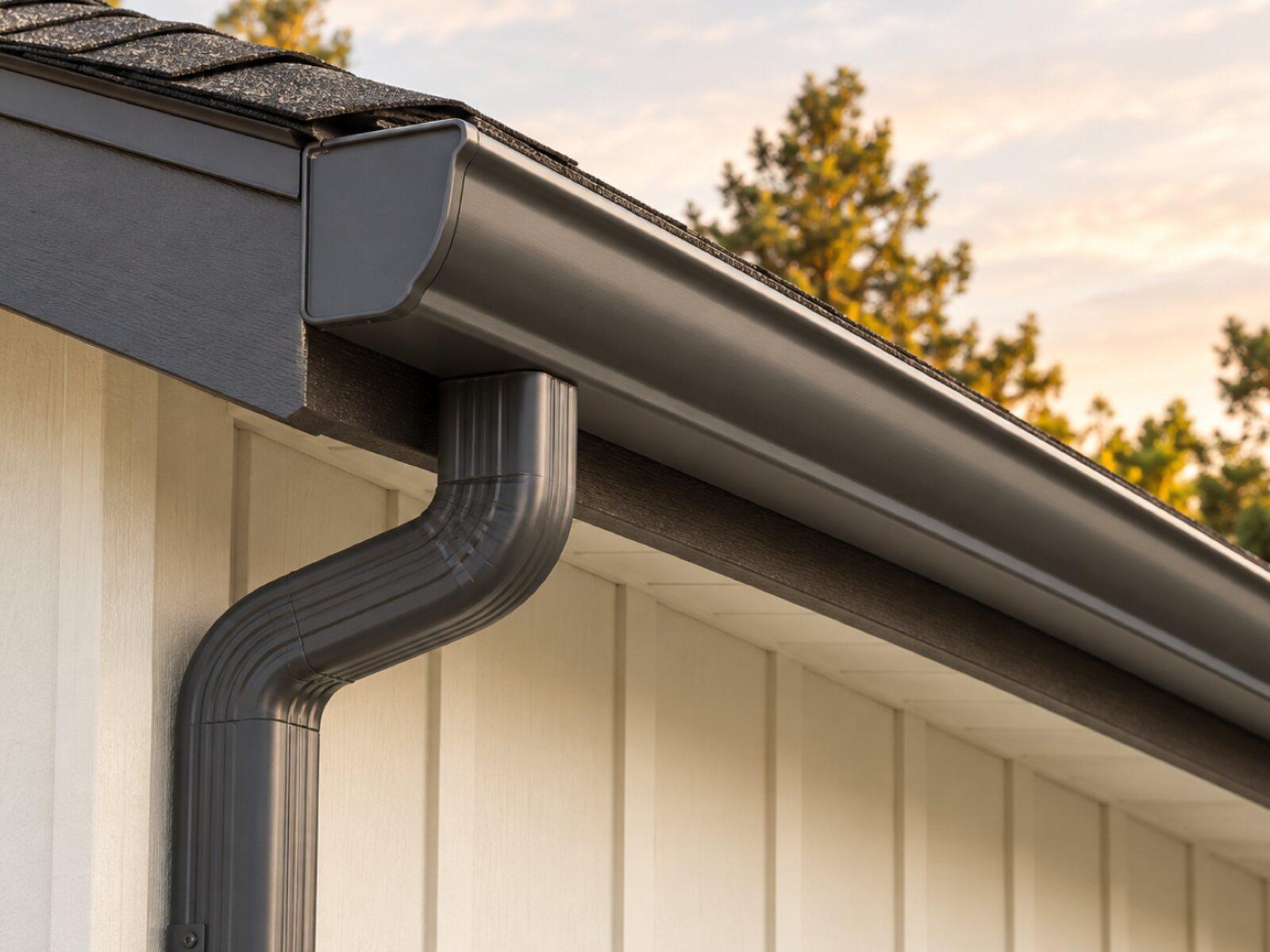
Keep a copy for your site visit or when comparing estimates.
Included in a written scope
- Removal and disposal of existing gutters and downspouts where replacement is planned
- Inspection of fascia, with repair or replacement written as its own line
- Seamless gutters formed on site, pitched to outlets, and hung on hidden hangers
- Downspouts placed for drainage, with extensions or splash blocks where water must be moved from the foundation
- Guards installed as specified, if selected
- Cleanup and removal of old material
Clarify before work starts
- How many downspouts and where each one discharges
- Whether fascia repair or painting is included
- Which guard style is quoted and how it is cleaned
- Whether underground drains are part of the scope
How a gutters project works
The stages to discuss when planning your project.
Talk through the project
Tell us what you want to repair or update. A few details about the home and what you have noticed are enough to start.
Review the home and options
A site review identifies the work involved, checks the usual trouble spots, and covers the choices that fit your home.
Agree on the scope and schedule
Review what is included, what is not, and how changes are handled before any work is scheduled.
Walk through the result
Review the completed work together, along with the applicable care and warranty information for what was installed.
Gutters questions from Roseville homeowners
Do I need a permit to replace gutters in Roseville?
Confirm it with the city; Roseville has not published an exemption for gutters. The Building Inspection Division’s permit-exemptions list, dated January 1, 2026, names painting and similar finish work and says nothing about gutters, so the scope is run past the division at 311 Vernon Street before the job is booked rather than assumed exempt. Two additions change the answer for certain: replacing rotted rafter tails or sheathing behind the fascia is structural work that needs a permit, and cutting a new drain line through the curb or sidewalk needs an Encroachment Permit from Engineering. HOA color review in Westpark or Sun City Roseville is separate.
Are gutter guards worth it under Roseville's oaks?
Under a valley oak in Diamond Oaks or Sierra Gardens, usually yes; on a treeless West Roseville lot, usually not. Oak leaves and spring catkins are small and pack a gutter corner fast, so a micro-mesh guard on the runs under the canopy means far fewer cleanouts and a lower chance of a January overflow soaking the fascia. The same guard on a Westpark house with no canopy is money spent on a problem the house does not have. Guards still need the outlets checked each fall, and the gutter guard breakdown covers the product differences.
Why do my Westpark gutters overflow at the corners in a big storm?
On a Westpark two-story the usual suspect is a roof valley. Where two roof planes meet above an inside corner, the whole valley’s water arrives at one spot in a burst, and a standard 5-inch gutter with the outlet somewhere else cannot swallow it during an atmospheric-river storm. The fixes, in order of cost, are a splash guard at the corner, a second downspout close to the valley, or a 6-inch gutter on that run. Before any of that, the crew checks that the existing downspout and the buried line it feeds are clear, because a blocked drain overflows the same corner.
Where should downspouts discharge on a flat West Roseville lot?
Into the buried drain line the builder installed, if it still works. Many 2000s–2010s West Roseville lots in Westpark and Fiddyment Farm were graded nearly flat with each downspout piped underground to a curb core at the street, and a flat lot has nowhere else to send water without pooling at the foundation. Before new gutters go on, each line gets flushed and watched at the curb; a line that will not drain gets cleared or replaced, and that is a separate scope from the gutters. Splash blocks are a fallback only where the yard grades away from the house. Discharging onto a neighbor’s lot is not an option.
Should I replace the gutters when the tile underlayment is redone?
Only if they are at the end of their life, but it is the cheapest moment to do it. A tile lift-and-relay on a Johnson Ranch or Sun City Roseville roof exposes the fascia and the drip edge, so rotted fascia gets replaced and the new eave metal gets lapped correctly into the gutter, which is hard to do afterward. Aluminum gutters that are straight, sealed at the seams and hanging on sound fascia can stay; the roofer protects them and resets any hangers disturbed by the edge work. Have the roofing and gutter scopes name who removes, protects and reinstalls what, so nothing is left between two contractors.
Does the HOA care about gutter color?
In Roseville’s HOA tracts, yes. Westpark, Fiddyment Farm, Blue Oaks and Sun City Roseville treat gutter and downspout color as a visible exterior change; matching the existing color is the simplest case, while switching from the builder’s match-the-fascia color to a contrasting trim color is the kind of change that needs an application. Seamless aluminum is roll-formed on site in the chosen color, so the finish is confirmed in writing before the truck arrives. The contractor’s scope should record the agreed color and state who is filing the architectural request.
Tell us about your Roseville gutters project.
Share what you have noticed and what you would like to change. We'll review the details and contact you about the next step.
No budget, address, or photos needed to inquire.
Other exterior services in Roseville
- Siding replacement for Roseville homesExplore repair and replacement options for your home's exterior walls.
- Window & door replacement for Roseville homesFind an updated look and a fit that works for your home.
- Roof replacement for Roseville homesPlan the next step for a worn or damaged roof.
- Exterior painting for Roseville homesRefresh the finish, starting with the preparation underneath.
- Dry rot & trim repair for Roseville homesAddress damaged wood and understand the work around it.
Gutter installation in other communities we serve
Sacramento County
- Gutter installation for Sacramento homes
- Gutter installation for Folsom homes
- Gutter installation for Elk Grove homes
- Gutter installation for Citrus Heights homes
- Gutter installation for Carmichael homes
- Gutter installation for Fair Oaks homes
- Gutter installation for Rancho Cordova homes
- Gutter installation for Arden-Arcade homes