
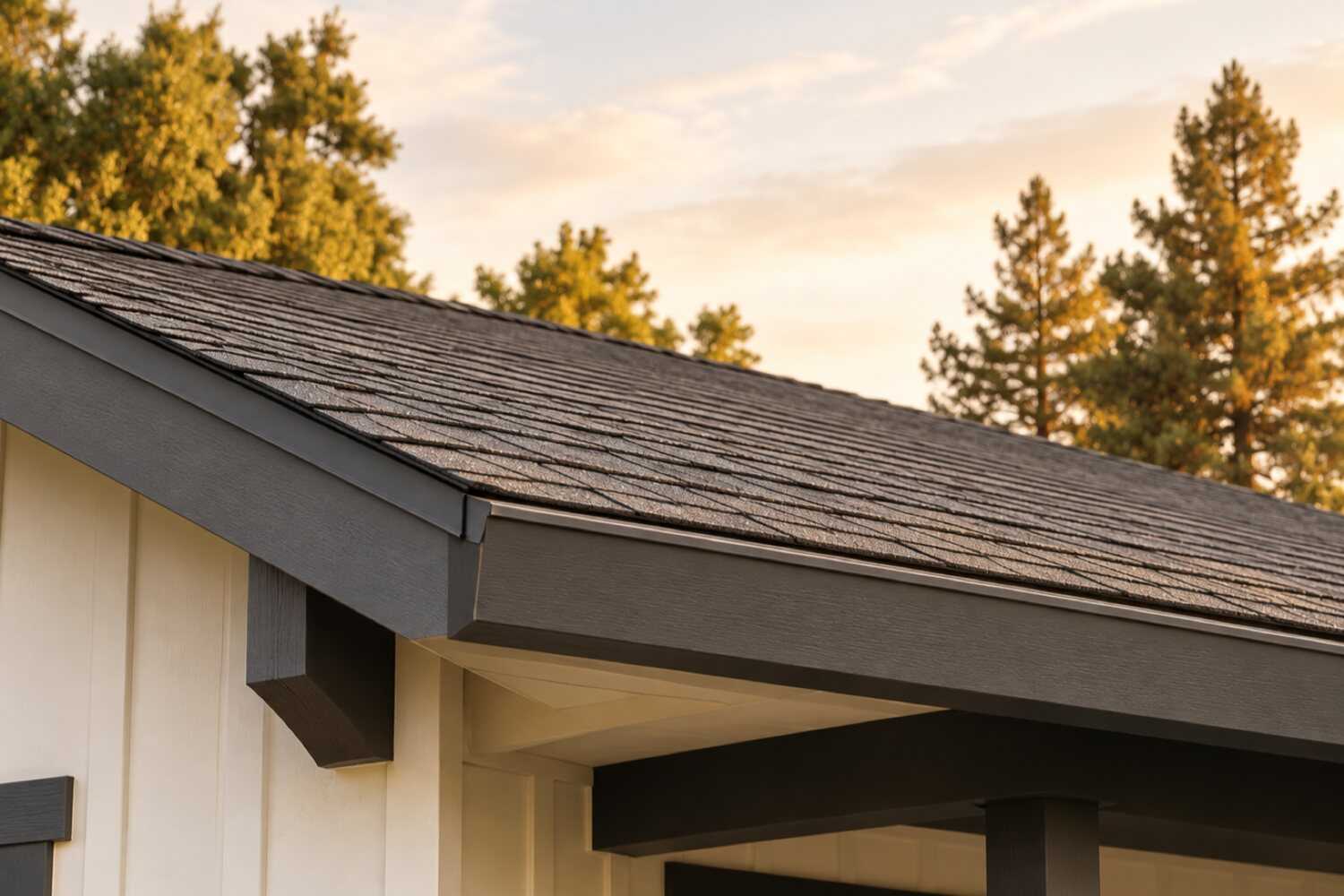
Roof replacement and repair in Carmichael, CA.
A Carmichael roof may include pitched and low-slope sections that need different assemblies. Measure each section, inspect the deck and drainage, and check how trees or access constraints affect the work.
What roof replacement costs in Carmichael
Published figures put a composition reroof in Carmichael at $6,752–$8,720 for a 1,282-square-foot roof (homeyou) and $12,200–$19,200 for 2,500 square feet in the Sacramento market (HomeBlue); repairs are itemized after inspection. Resheeting a former-shake deck, membrane work on flat midcentury wings and tree clearance move the number.
| Scope | Published range | What it usually includes |
|---|---|---|
| Localized repair, defined after inspection | Itemized project estimate | The sources used here do not provide a comparable Carmichael repair model. Identify the affected flashing, penetration, valley or roof area and the proposed repair before requesting a price. |
| Shingle model, 1,282 sq ft of roof | $6,752–$8,720 | homeyou's Carmichael roof-replacement example for 1,282 square feet. Verify the actual roof area, removal layers, decking and roof-system specification before treating it as comparable to a bid. |
| Asphalt model, 2,500 sq ft of roof | $12,200–$19,200 | HomeBlue's September 2024 Sacramento installed asphalt example. Its separate 2,000-square-foot model is $9,800–$15,300. These are roof-area examples, not estimates based on conditioned living area. |
Ranges are published third-party figures, not 916 Exteriors prices; the written estimate is the only number that applies to your home.
How to compare these ranges
Record what is under the shingles and what the replacement system needs. At a Carmichael home with evidence of a prior shake roof, inspect whether the deck is solid and suitable rather than assuming all houses from the same decade need a full resheet.
Ask for tear-off layer counts, disposal, flashing locations and a per-sheet rate for concealed decking work. A low-slope wing needs its own assembly description and drainage assessment.
Tree clearance and protected access should appear where required for this property. Neither a broad metro average nor a modest roof pitch establishes the final price.
Keep any solar coordination, gutter work and structural repairs visible as separate scope items, with responsibility assigned. The Sacramento roof replacement cost guide compares regional materials and project models.
Read next: How much does a roof replacement cost in Carmichael?
What changes the price in Carmichael
- Resheeting over former shake decks
- Spaced sheathing under a 1960s or 1970s roof gets solid plywood or OSB before new underlayment; priced per sheet and common in Carmichael.
- Low-slope and flat sections
- Membrane roofing, tapered insulation, and scuppers on midcentury wings are a separate scope at a separate rate from the shingle field.
- Tree canopy and limb work
- Clearance over the roof, debris-heavy tear-off, and staging around oaks and redwoods add time on river-side streets.
- Multiple tear-off layers
- Two layers of composition, or composition over the remains of shake, adds labor and disposal.
- Cool-roof products
- Where Title 24 applies to a low-slope section in zone 12, a rated membrane or coating is specified.
- Solar detach and reset
- Arrays on SMUD-area roofs are removed and reinstalled by a solar contractor as a separate line.
Compare your roofing options
Choose two options to compare the upkeep, fit and installation details.
| Compare | Composition (asphalt) shingle | Concrete or clay tile |
|---|---|---|
| Appearance | Most common local look; many colors and profiles | Distinctive profile; common on stucco homes |
| Maintenance | Periodic inspection; debris and gutter cleaning | Underlayment eventually needs renewal beneath the tile |
| Where it fits | Sloped roofs; wide product range | Structure must carry the weight |
| Installation | Tear-off, underlayment, flashing, ridge and ventilation details | Often re-laid over new underlayment rather than replaced |
View all 4 options and planning notes
Composition shingle is the most common roof in the region and the least expensive to replace; it suits any sloped roof and comes in many grades. Concrete or clay tile is heavier, costs more, and is usually relaid over new underlayment rather than replaced. Standing-seam metal costs the most, lasts the longest, and suits ranch and modern styles. Low-slope sections, common over additions and porches, need a membrane rather than shingles.
| Option | Appearance | Maintenance | Where it fits | Installation notes |
|---|---|---|---|---|
| Composition (asphalt) shingle | Most common local look; many colors and profiles | Periodic inspection; debris and gutter cleaning | Sloped roofs; wide product range | Tear-off, underlayment, flashing, ridge and ventilation details |
| Concrete or clay tile | Distinctive profile; common on stucco homes | Underlayment eventually needs renewal beneath the tile | Structure must carry the weight | Often re-laid over new underlayment rather than replaced |
| Standing-seam metal | Clean vertical lines; wide color range | Low; fastener and sealant checks over time | Sloped roofs; suits modern and ranch styles | Panel fabrication and detailing require specialty work |
| Low-slope membrane | Flat or near-flat sections, usually not visible from the street | Keep drains clear; inspect seams | Porches, additions, and flat sections | Different materials and crews than sloped roofing |
Fire ratings, wind ratings, and warranty terms are published by each manufacturer and confirmed per product, not assumed here. Manufacturer names appear once 916 Exteriors confirms the products it installs and the licensing that applies.
Planning roofing work in Carmichael
Open the topics that apply to your property.
A Carmichael reroof differs from the neighbors in deck and shape. Citrus Heights, with 40% of its homes from the 1970s, is a composition-over-composition market on steeper tract gables, permitted through the city. Fair Oaks to the east has more 1980s and 1990s roofs, including tile, and its river-bluff lots add slope to the staging. Rancho Cordova across the river has nearly a third of its housing from 2000 on, where the reroof is the first one the house has had. Carmichael's job is the former-shake deck under a low-pitched 1960s ranch, the flat midcentury wing that needs a membrane, and the oak and redwood canopy over both. All of it is permitted through Sacramento County.
Compare nearby: Roof replacement in Fair Oaks · Roof replacement in Arden-Arcade · Roof replacement in Citrus Heights
Roof replacement for Carmichael homes
Carmichael roofs are low-pitched and wide. The 1950s and 1960s custom ranches, 40% of the housing, were built with shallow hips and gables spread over long single-story plans. Many have a flat or near-flat wing where a carport, breezeway or family room was added. The 1970s tracts, 27%, are steeper but not by much. Most of the pitched roofs started as cedar shake; the Del Dayo moderns started as tar and gravel over tongue-and-groove decking with no attic at all.
The tear-off finding that matters most here is the deck. Shake was laid on spaced boards. When Carmichael's shake roofs were converted to composition, some got plywood over the skip sheathing and some got shingles nailed across the gaps. A crew can usually see which from the attic. If the tear-off exposes skip sheathing, the deck is resheeted, and that line is priced per sheet before the job starts. The flat wings are the second finding: ponding at the corners, scuppers rusted out, and rigid insulation that was never there.
Carmichael's trees set the rest of the scope. Redwood needles and oak leaves fill the valleys and pile against the chimney on the north slope, and moss grows under the canopy. Limbs within reach of the roof are cleared before staging, and native oaks fall under the county's tree ordinance. The estimate separates the shingle field, the low-slope membrane work, the resheeting allowance, the tree clearing and any solar detach-and-reset, so each can be compared. The Sacramento roof cost guide gives the published models by roof area.
Housing age and what to inspect
Housing age helps plan an inspection. The share of homes in each decade is census data; the notes describe materials and conditions to check at the property.
| Built | Share of homes |
|---|---|
| Before 1940 | 1% |
| 1940–1949 | 3% |
| 1950–1959 | 18% |
| 1960–1969 | 22% |
| 1970–1979 | 27% |
| 1980–1989 | 15% |
| 1990–1999 | 6% |
| 2000–2009 | 5% |
| 2010 and later | 2% |
Carmichael: 33,048 housing units, median year built 1972, median owner-occupied value $579,500, 52% owner-occupied. Source: U.S. Census Bureau, American Community Survey 2020–2024 5-Year Estimates, tables B25034 (year structure built), B25035 (median year built), B25077 (median value, owner-occupied), B01003, B25003 (ACS 2024 5-year).
- Postwar homes1940s–1950s (about 21% of homes)
- The 1950s Colony ranches have shallow hips and gables over long single-story plans with open eaves, and most started under shake on skip sheathing. Seventy years on, many are on a second composition layer, and the decking under them may be spaced boards, solid boards, or a plywood overlay from an earlier reroof. The tear-off determines which, and the attic usually gives a preview. The exposed rafter tails at the eave are the other finding. Soft tails are replaced before the drip edge goes on, and that is structural work under the reroof permit.
- 1960s construction1960s (about 22% of homes)
- Carmichael's 1960s roofs come in two kinds. The ranches carry shake-era decks like the 1950s houses, with wider valleys and more penetrations from added bathrooms. The Del Dayo moderns carry flat or near-flat roofs over tongue-and-groove decking that is also the ceiling, originally tar and gravel, now usually a patched membrane. Those flat sections are the Carmichael specialty. They get tapered insulation to end the ponding, new scuppers and overflows, and the only chance the house will have to add rigid insulation above the deck. They are priced as their own system, apart from the shingle field.
- 1970s build-out1970s (about 27% of homes)
- The 1970s tract roofs north of Fair Oaks Boulevard and on the infill Colony lots are gables at a moderate pitch. Most started as shake on skip sheathing and have been converted to composition once already. Two-layer tear-offs are common: composition over the remains of shake. The plumbing and furnace penetrations are aging, pipe boots are cracked, and the valleys under the redwoods are full. The year matters twice. A house built before 1978 has lead-era paint on the fascia that comes off with the drip edge, and a 1970s attic usually shows whether the deck was ever sheeted.
- Later tracts and infill1980s–1990s (about 21% of homes)
- The 1980s and 1990s houses are Carmichael's first composition-from-new roofs, plus some concrete tile on the larger infill homes and shared roofs on the corridor condominiums. A 1980s composition roof has been replaced once by now; a 1990s one is due. Tile roofs here are usually a lift-and-relay over new underlayment rather than new tile. Condominium roofs are association work, bid per building. Solar arrays sit on some of these roofs and are detached and reset by a solar contractor as a separate line.
Roofing by neighborhood in Carmichael
- Del Dayo
- Del Dayo's post-and-beam houses from the 1950s and 1960s have flat and low-slope roofs over exposed tongue-and-groove decking, with no attic between the roof and the rooms below. A reroof here is membrane work: tapered insulation, scuppers and overflows, and rigid insulation above the deck, with the shingle field on any pitched section priced separately. Leaks show inside as stained decking, which is the ceiling.
- Carmichael Colony
- The Colony parcels carry Carmichael's widest spread of roof ages on one street: a 1950s hip on a former-shake deck beside a 1975 gable already converted to composition once. Each house gets its own deck check from the attic before the estimate, because one may need full resheeting and the next may not. Long single-story eaves mean long drip-edge and fascia runs.
- Wilhaggin edge
- Where Carmichael meets Wilhaggin, the large custom ranches have big, low-pitched hip roofs with several valleys, added wings and, on many, a remodel-era skylight or two. Roof area runs well above the published 1,282- and 2,500-square-foot models, and the canopy over these lots means limb clearance and debris-heavy tear-off. The estimate measures the actual planes and prices the valleys and penetrations.
- Ancil Hoffman Park area
- Roofs off California Avenue beside Ancil Hoffman Park sit under the heaviest oak canopy in Carmichael, and the north slopes hold moss and litter through the winter. The scope here includes limb clearance, which for native oaks may need a county tree permit and an arborist, and a debris-tolerant valley detail. Underlayment choice matters more than shingle grade on a roof that never fully dries between November and April.
- Fair Oaks Boulevard corridor
- Along Fair Oaks Boulevard, the 1960s–80s apartment and condominium buildings have shared low-slope and gable roofs over two-story walk-ups, reroofed as association or owner projects. The estimate is per building: roof area by plane, the low-slope sections as membrane, and a staging plan that keeps parking and entries open during tear-off.
- North Carmichael off Madison Avenue and Dewey Drive
- North of the Colony parcels, the 1960s–70s tract streets toward Madison Avenue have the community's most uniform roofs. They are moderate-pitch gables, originally shake, converted to composition, on lots with fewer big trees than the river side. These are the straightforward Carmichael reroofs, with the deck check and a two-layer tear-off as the main variables and easy driveway staging.
Sun, rain, trees and site conditions
Carmichael is climate zone 12 on the valley floor. Summer heat cooks south and west slopes. Composition shingles lose granules and pipe boots crack faster on those planes, and a Del Dayo flat roof over an uninsulated deck turns the room below into an oven. Title 24 cool-roof requirements may apply to a low-slope reroof here, and a rated membrane or coating is the usual way to meet them. Confirm the compliance path against the CEC standards and with the county.
Winter is the other half. About 18 inches of rain falls between November and March, often in a few atmospheric-river storms, and a low-pitched roof sheds it slowly. Valleys full of redwood needles and oak leaves back water up under the shingles; a flat roof with a plugged scupper ponds. Moss on north slopes under the canopy holds moisture against the shingle. Underlayment, valley metal and clean scuppers do more for a Carmichael roof's life than shingle grade.
The canopy sets the access. Valley oaks, live oaks and tall redwoods on the Colony lots and along the parkway overhang roofs and block lift placement. Limbs are cleared first. Native oaks fall under Sacramento County's tree ordinance, so heavy pruning goes through a tree service and may need a permit. The foothill wildfire-zone rules that shape roofing in El Dorado Hills are not a routine part of a Carmichael reroof; Class A composition is the standard product here anyway. Confirm parcel-level rules with the county.
Permits and approvals
Reroofing in Carmichael is permitted through Sacramento County Building Permits & Inspection; the community is unincorporated and has no city building department. A reroof permit is standard, and the inspection is how the county checks the underlayment, flashing, and any resheeting before the roof is closed. The licensed contractor pulls the permit and schedules the inspection; the estimate states this so you are not taking on owner-builder responsibility.
Check recorded material and color restrictions before selecting the roofing product. A private architectural approval is separate from the reroof permit; cool-roof values and the fire rating of the assembly are checked at the County inspection, not by the association letter. If associated eave repair disturbs older painted wood, verify the building year and applicable lead-safe procedures. Name the parties responsible for those approvals and for any solar coordination before scheduling tear-off.
Permit authority: Sacramento County Building Permits & Inspection . Whether a permit or review applies, and who pulls it, is written into the estimate.
Seeing something on your own house? Request an estimate for roofing in Carmichael
Repair or replace?
A roof with years left can still leak at one bad flashing. A roof at the end of its life may look fine from the street. The decision rests on condition, not just age.
Not sure which applies? Tell us what you are seeing and request an estimate for roofing.
What the scope includes
A complete estimate names the work, materials and exclusions so you can compare proposals.
Keep a copy for your site visit or when comparing estimates.
Included in a written scope
- Tear-off and disposal of existing roofing to the sheathing where replacement is planned
- Inspection of sheathing, with replacement priced as a separate line per sheet
- Underlayment, drip edge, and flashing at walls, chimneys, vents, and valleys
- New roofing installed to the product's published instructions
- Ridge, ventilation, and pipe boots as specified
- Magnetic nail sweep of the yard and driveway and daily cleanup
Clarify before work starts
- How sheathing replacement is priced and approved during the job
- Whether gutters are removed and reinstalled or replaced as part of the work
- How skylights, solar mounts, and satellite dishes are handled
- Permit requirements and who is responsible for inspection scheduling
How a roofing project works
The stages to discuss when planning your project.
Talk through the project
Tell us what you want to repair or update. A few details about the home and what you have noticed are enough to start.
Review the home and options
A site review identifies the work involved, checks the usual trouble spots, and covers the choices that fit your home.
Agree on the scope and schedule
Review what is included, what is not, and how changes are handled before any work is scheduled.
Walk through the result
Review the completed work together, along with the applicable care and warranty information for what was installed.
Roofing questions from Carmichael homeowners
Is a permit required to reroof a house in Carmichael?
Yes, in the normal case. Carmichael is unincorporated Sacramento County, so the reroof permit comes from Sacramento County Building Permits & Inspection, and the county inspects underlayment, flashing, and any new sheathing before the roof is closed. The licensed contractor pulls it. If you are told a permit is not needed for a full reroof, ask why, because that is where inspection of the deck gets skipped.
My 1970s Carmichael house had a shake roof once. Does that change the reroof?
It can, and it is the first thing checked. Shake was laid on spaced boards with gaps between them. When those roofs were converted to composition, some got solid plywood first and some did not. If the tear-off exposes spaced sheathing, the deck is resheeted with plywood or OSB before underlayment, priced per sheet at a rate written into the estimate in advance. A crew can often tell from the attic before the job whether that line will be used.
The flat part of my Del Dayo roof leaks. Can it be shingled?
No. Shingles need pitch to shed water, and a flat or near-flat section needs a membrane: modified bitumen or a single-ply such as TPO, with tapered insulation to drain the corners that pond and new scuppers and overflows. Because these roofs sit over exposed tongue-and-groove decking with no attic, the membrane job is also the only chance to add rigid insulation above the deck. Title 24 cool-roof requirements for low-slope roofs in climate zone 12 may apply, and the estimate names a compliant product.
Do I have to trim the oaks over my roof before a reroof?
Limbs touching or within a few feet of the roof surface are cleared before the job so the crew can stage and so the new roof does not get abraded the first windy week. Native oaks are protected under Sacramento County's tree preservation ordinance, so heavy pruning or removal may need a county tree permit and is done by a tree service to arborist standards; it is scheduled ahead of the roof and is not part of the roofing scope. The estimate names what needs to be cleared and who does it.
Should gutters be replaced with the roof on a Carmichael ranch?
Usually. The original sectional aluminum on a 1970s ranch comes off with the drip edge anyway, the fascia behind it is where rot hides on these houses, and the oak and redwood litter calls for a guard chosen for it. Doing gutters in the same project means the fascia is repaired, the drip edge and gutter are set together, and the roof edge is worked once. It is priced as an option beside the roofing scope.
How long does a composition roof last in Carmichael?
Manufacturers publish the warranty term for each product and that is the number to use, not a rule of thumb. What Carmichael adds is the heat, which ages south and west slopes faster, and the shade, which grows moss on north slopes under oaks and redwoods. Keeping litter out of the valleys and off the north side, and replacing cracked pipe boots when they show up, is what gets a roof here to the end of its rated life.
Tell us about your Carmichael roofing project.
Share what you have noticed and what you would like to change. We'll review the details and contact you about the next step.
No budget, address, or photos needed to inquire.
Other exterior services in Carmichael
- Siding replacement in Carmichael, CAExplore repair and replacement options for your home's exterior walls.
- Window & door replacement in Carmichael, CAFind an updated look and a fit that works for your home.
- Exterior painting in Carmichael, CARefresh the finish, starting with the preparation underneath.
- Gutter installation in Carmichael, CAPlan how rainwater moves from the roof and away from the home.
- Dry rot & trim repair in Carmichael, CAAddress damaged wood and understand the work around it.