
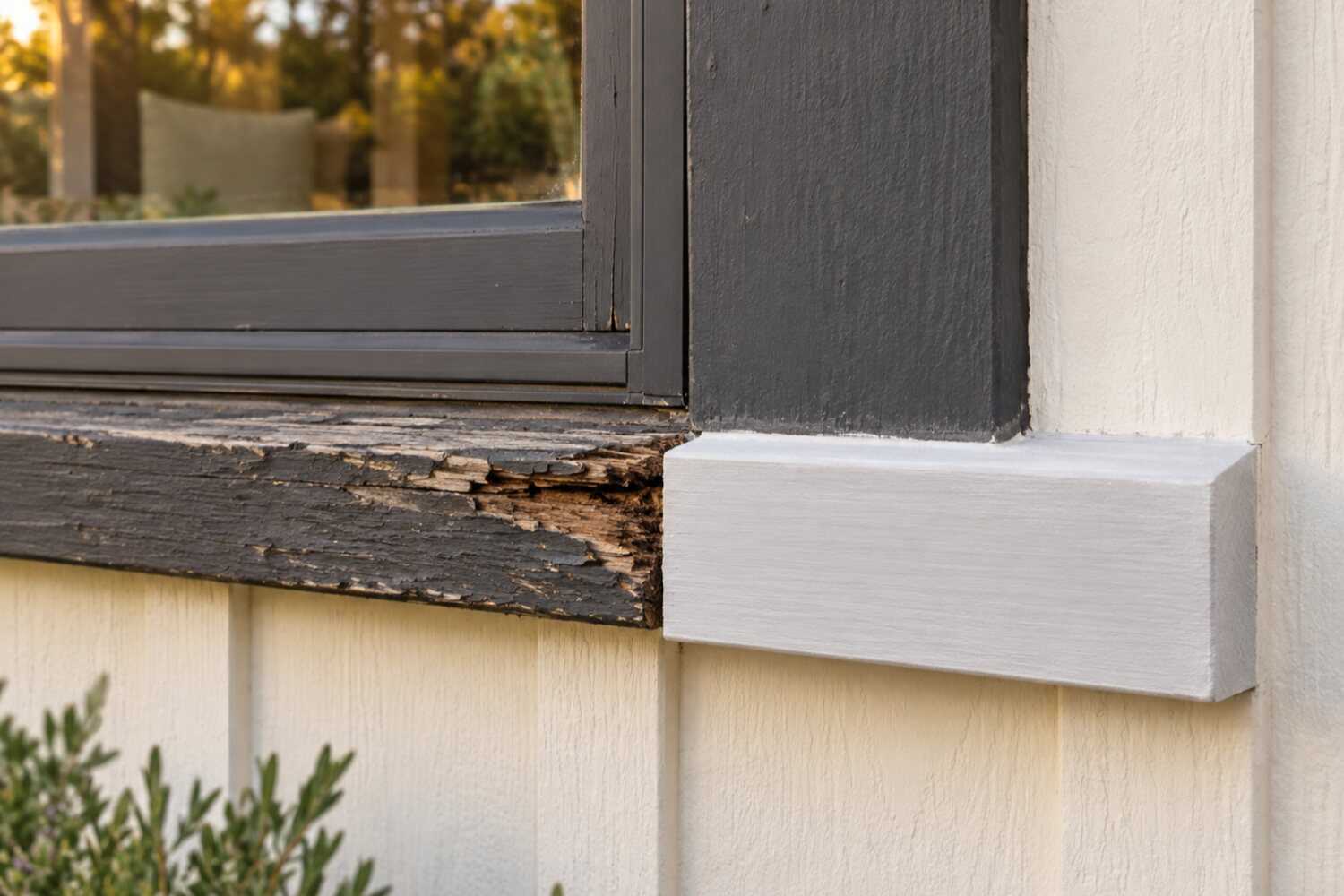
Dry rot and exterior trim repair in Rancho Cordova, CA.
A Rancho Cordova rot repair begins with the damaged location and moisture source, whether the finding is in older siding, fascia, window trim, or a newer accent.
What dry rot & trim repair costs in Rancho Cordova
Regional published figures put dry rot repair for Rancho Cordova homes at $140–$800 for a small trim or fascia repair, $500–$2,351 for a typical job and $2,500–$6,500 or more for structural framing (Vertex Maintenance, citing Angi 2026); Good Life Inspections lists $5,000–$10,000 and up for severe work. Water travel, two-story staging and buried weep screeds move the number.
| Scope | Published range | What it usually includes |
|---|---|---|
| Small repair, Vertex reference | $140–$800 | Vertex Maintenance’s Sacramento figure for a small trim, fascia, or sill repair, which is the size of a Cordova Meadows rafter-tail splice or one soft corner board; Good Life Inspections lists $500–$1,500 for minor repairs. Both are regional publisher figures, and on the old grid the lead-safe setup is part of even the smallest one. |
| Typical repair, Vertex reference | $500–$2,351 | Vertex Maintenance’s published Sacramento range, with an average near $1,425; Good Life Inspections lists $2,000–$5,000 for moderate work. In Rancho Cordova this band covers a run of gutter-side fascia, several T1-11 panel bottoms in Lincoln Village, or the sill under a 1960s slider, and neither publisher fixes a piece count or says whether flashing is in the number. |
| Structural repair, Vertex reference | $2,500–$6,500+ | Vertex Maintenance’s Sacramento structural-repair range; Good Life Inspections lists $5,000–$10,000+ for severe or structural work. Here that is a balcony ledger on a Lincoln Village two-story, a sill plate behind a buried Anatolia weep screed with the stucco cut and patched, or porch framing in Capital Village, each with a city permit and staging. Keep the two publishers’ bands separate rather than averaging them. |
Ranges are published third-party figures, not 916 Exteriors prices; the written estimate is the only number that applies to your home.
How to compare these ranges
Rancho Cordova rot pricing is driven by how far the water traveled, not by how much rot shows. A soft corner board in Cordova Meadows can be a short splice or the visible end of a rotted stud bay, and the difference is found with a probe before the number is written.
Height moves the price next: fascia and ledgers on the two-story tracts need staging that a single-story ranch does not. Then the era: lead-safe containment on the confirmed pre-1978 houses adds setup to every repair, a slider-sill repair on a 1960s house often becomes a window replacement, and a buried weep screed in Anatolia means cutting stucco to reach the plate.
Several small repairs across one house add setup time each, which is why the estimate groups them by elevation. None of the figures above is a 916 Exteriors price; the written estimate, with a unit rate for damage found once the piece is off, is.
Sources
- Vertex Maintenance: Dry rot repair cost in Sacramento (citing Angi 2026 data)
- Good Life Inspections: Dry rot repair cost in 2026 (Sacramento)
- U.S. EPA: Renovation, Repair and Painting Program
- California Structural Pest Control Board
- City of Rancho Cordova: Building and Safety
- Anatolia Homeowners Association: Architectural Control Committee
- U.S. Census Bureau: ACS 2020–2024 5-year, Rancho Cordova housing by year built
Read next: How much does dry rot repair cost in Rancho Cordova?
What changes the price in Rancho Cordova
- How far the water traveled
- A trim splice and a stud-bay repair look alike from the curb; the probe decides which one it is, and the per-foot rate covers what is found.
- Lead-safe containment on pre-1978 homes
- Every repair on the old grid disturbs painted wood, so containment and a certified crew are part of each line.
- Two-story height
- Fascia, ledgers, and upper trim in Anatolia, Zinfandel, and the 1970s two-story models need staging or a lift.
- Cutting stucco to reach the plate or ledger
- Buried weep screeds and balcony ledgers on the tracts mean opening and patching stucco around the repair.
- Sliders that become window jobs
- A rotted sill under a 1960s aluminum slider is often best fixed with a full-frame replacement, which is its own permitted line.
- Number of locations
- Six small repairs around one ranch cost more than one large one because each carries setup, containment, and paint blending.
- HOA color match
- Repairs in Anatolia and Zinfandel are painted to the approved scheme, and a visible profile change goes through review.
Compare repair materials
Choose two options to compare the upkeep, fit and installation details.
| Compare | Primed finger-joint wood trim | Fiber cement trim |
|---|---|---|
| Appearance | Smooth, paint-grade profile that matches most existing trim | Smooth or wood-grain; holds paint |
| Maintenance | Repaint on the normal cycle; keep end cuts sealed | Repaint; resists rot and insects |
| Where it fits | Most trim and fascia replacements | High-exposure trim, corner boards, and fascia |
| Installation | Back-prime and seal cuts; keep off the ground | Heavier; requires proper fasteners and gaps |
View all 4 options and planning notes
Primed finger-joint wood is the usual replacement for painted trim because it matches existing profiles and takes paint well; fiber cement trim costs more and resists rot and insects on the most exposed pieces; cellular PVC is the choice where wood touches the ground or stays wet. Epoxy consolidation saves a historic profile with limited damage, but only after the water source is fixed. None of them stays dry without correct flashing.
| Option | Appearance | Maintenance | Where it fits | Installation notes |
|---|---|---|---|---|
| Primed finger-joint wood trim | Smooth, paint-grade profile that matches most existing trim | Repaint on the normal cycle; keep end cuts sealed | Most trim and fascia replacements | Back-prime and seal cuts; keep off the ground |
| Fiber cement trim | Smooth or wood-grain; holds paint | Repaint; resists rot and insects | High-exposure trim, corner boards, and fascia | Heavier; requires proper fasteners and gaps |
| Cellular PVC trim | White, smooth; can be painted light colors | Very low; expands with heat | Ground contact and constant-wet locations | Needs expansion gaps and compatible adhesives |
| Epoxy consolidation | Original piece retained and filled | Paint; inspect for movement | Historic or hard-to-match profiles with limited damage | Only when the remaining wood is stable and the source is fixed |
Which material is proposed for each location is written in the estimate, along with the flashing or sealing change that stops the water.
Planning dry rot & trim work in Rancho Cordova
Open the topics that apply to your property.
Rot repair in Rancho Cordova differs from Carmichael, Folsom and Sacramento in where the water comes from. Carmichael and Fair Oaks across the river sit under oak canopy, so their rot is in slow-drying north walls and decks over damp ground, under Sacramento County permits. Folsom has decks and ledgers over sloped lots on the canyon edge and historic review on Sutter Street. Sacramento's prewar districts have porch framing and wood windows under Preservation Commission rules. Rancho Cordova is flat, sunny on its south half and shaded only on the old grid, so the water comes from gutters, sprinklers and grade instead of slope or canopy. The repairs cluster at eaves, panel bottoms, slider sills and buried weep screeds, and the permit comes from a city that has issued them only since 2003.
Compare nearby: Dry rot & trim repair in Folsom, CA · Dry rot & trim repair in Sacramento, CA · Dry rot & trim repair in Carmichael, CA
Dry rot & trim repair for Rancho Cordova homes
Dry rot in Rancho Cordova shows up in different places on the two halves of the city. Half the housing predates 1980 (U.S. Census Bureau, ACS 2020–2024 5-year). On that older grid north of Highway 50 the rot is in the open-eave fascia and rafter tails of Cordova Meadows and the T1-11 panel bottoms of Lincoln Village. It is in redwood corner boards and bottom courses set an inch off the slab, and in the sills under sixty-year-old aluminum sliders. On the 2000s tracts south of the highway, in Anatolia, the Villages of Zinfandel, Sunridge Park and Kavala Ranch, it hides behind stucco at a buried weep screed, at the top edge of foam trim and under balcony ledgers. In Capital Village it sits in the porch columns and brackets.
Each of those has a known water path. Gutter overflow on open eaves wets the fascia and the first foot of deck. Sprinklers and splash wet the exposed end grain at the bottom of a T1-11 panel and the bottom course of lap. A slider with no sill pan sends every winter storm into the framing under it. Bark and raised beds bury the weep screed so the stucco cannot drain and the sill plate sits wet. The repair that lasts fixes the path first: move the downspout, clear the screed, flash the sill, give the bottom course clearance. A new board in the same wet spot rots again.
A written dry rot and trim scope for a Rancho Cordova house locates each repair, names the replacement material and profile, and states the water-path correction. It gives a unit rate for damage found once the piece is off, with photographs and approval before the quantity grows. It says which lines are structural and permitted through the city and which are trim. On confirmed pre-1978 houses every repair disturbs painted wood, so lead-safe containment is a line in each. The signs of dry rot guide covers what to look for before calling; the neighborhoods below say where to look in this city.
Housing age and what to inspect
Housing age helps plan an inspection. The share of homes in each decade is census data; the notes describe materials and conditions to check at the property.
| Built | Share of homes |
|---|---|
| 1940–1949 | 1% |
| 1950–1959 | 11% |
| 1960–1969 | 17% |
| 1970–1979 | 22% |
| 1980–1989 | 11% |
| 1990–1999 | 7% |
| 2000–2009 | 17% |
| 2010 and later | 13% |
Rancho Cordova: 29,313 housing units, median year built 1979, median owner-occupied value $477,600, 58% owner-occupied. Source: U.S. Census Bureau, American Community Survey 2020–2024 5-Year Estimates, tables B25034 (year structure built), B25035 (median year built), B25077 (median value, owner-occupied), B01003, B25003 (ACS 2024 5-year).
- 1950s–1960s homes1950s–1960s (28% of homes)
- The 1950s and 1960s ranches in Cordova Meadows and the first postwar tract at Folsom Boulevard and Zinfandel Drive have open eaves with exposed rafter tails, redwood or fir fascia, and lap bottom courses close to grade. Their aluminum sliders went in without pans. Crews find the tail ends and the first foot of fascia soft on the gutter side, the bottom course rotted where it meets the planter, and sills soft under the sliders. Probe every tail, corner board and sill. The scarf splice on a tail is trim work; the sill and the framing under it are structural and permitted. Both carry lead-safe containment where the build date is confirmed.
- 1970s homes1970s (22% of homes)
- The 1970s T1-11 and hardboard houses in Lincoln Village and the later Cordova Meadows streets rot from the panel bottom up. The exposed plywood end grain wicks sprinkler water and the grooves deliver rain to the same edge. Two-story plans add balconies with ledgers into the wall and hardboard trim at the second-floor line. The repair cuts the panel back to sound wood and splices in new material behind a flashed horizontal joint; a ledger repair is structural and needs the permit. Price the panel splices by the foot and the ledger by the opening.
- 1980s–1990s homes1980s–1990s (18% of homes)
- The 18% of houses from the 1980s and 1990s pair stucco with hardboard gables, pot shelves and decorative bands whose top edges hold water. Hardboard swells and delaminates at those edges and at the gable bottoms, and the stucco below a pot shelf stains where the shelf has no cap flashing. Replace the failed hardboard with fiber cement and add the cap flashing that was never there. Keep the stucco patch and paint blend as their own lines.
- 2000s and after homes2000s and after (30% of homes)
- Anatolia, the Villages of Zinfandel, Sunridge Park, Kavala Ranch and Capital Village hide their rot. It sits at a weep screed buried under bark or a raised bed, where the sill plate stays wet, at the top edge of foam trim that has opened, and under a balcony ledger. In Capital Village it is in the porch columns and brackets of the Craftsman fronts. The site review clears the screed and probes the plate before pricing. A soft plate means cutting stucco, a permit and a repaint to the HOA's approved color; a sound plate means clearing the screed and moving the downspout.
Dry Rot & Trim by neighborhood in Rancho Cordova
- Cordova Meadows
- Cordova Meadows is single-story 1950s–1960s ranch housing with open eaves, redwood fascia and lap set close to the slab, under a street-tree canopy that keeps the north side damp. Rafter tails and the first foot of fascia on the gutter side, and the bottom course at the planters, are where the probe sinks. Splices at the tails and a fiber-cement bottom course with real clearance are the usual scope.
- Lincoln Village
- Lincoln Village's 1960s–1970s T1-11 houses, many of them two stories with a balcony, put the rot at the panel bottoms and the balcony ledger. The panel splice with a flashed horizontal joint is trim work; the ledger is structural, permitted and staged. Price the two separately and probe the ledger before writing the number.
- The Mather Field Road corridor
- The tracts along Mather Field Road, built in the Mather Air Force Base years, mix ranches with enclosed patios and flat-roofed additions whose joints to the main house were never flashed well. The rot is at those joints and at the posts of the patio covers. Trace the leak at the addition roof before replacing the trim below it.
- Anatolia
- Anatolia is 2000s stucco on flat lots where the builders set the weep screed close to grade and the landscaping buried it. The stain at the base of the wall is the stucco wicking water off a wet sill plate. Clear the screed and probe the plate first. A soft plate is a structural repair with stucco cutting and a repaint to the Architectural Control Committee's approved color.
- Capital Village
- Capital Village is Craftsman-styled small-lot homes and townhomes with wood porch columns, brackets, casings and lap-sided gables, the most exterior wood on any 2000s tract in the city, under an association that reviews visible changes. Column bases and bracket top edges are where the water sits. Replace by the piece in matching profile, confirm what the townhome association covers, and paint to the approved scheme.
Sun, rain, trees and site conditions
Rancho Cordova is climate zone 12, flat at about 90 feet, with a wet season of roughly 18 inches between November and March that arrives in a few long atmospheric-river storms. Wood that stays wet through one of those storms and does not dry before the next is where rot starts. That means a T1-11 bottom edge, a fascia board under an overflowing gutter, or a sill plate behind a buried weep screed. The dry summer, with days over 100°F, hides the damage under paint that looks fine until a probe goes in.
Sprinklers are the year-round water source. Lawn heads that hit the bottom course, drip lines that keep the planter against the wall wet, and irrigation that runs all summer against a stucco base do what winter cannot. On the old grid the street-tree canopy and the Parkway oaks along Coloma Road keep north walls damp into spring. On the treeless tracts the sun side is dry and the rot is at grade, where the water is.
Termites share the wet wood. Subterranean termites turn up with rot at garage jambs on the slab and at corner boards near the ground on the older grid. Any sign of them calls for a licensed wood-destroying-organism inspection before the repair. Parcels near open land may carry fire-hazard mapping that Building & Safety applies to a replacement assembly; confirm the address before specifying vents or trim materials there.
Permits and approvals
Dry rot repair in Rancho Cordova becomes permitted work through the City of Rancho Cordova Building & Safety division once the rot reaches structure. Rafter tails, eave framing, sheathing, a sill plate behind a buried weep screed, a balcony ledger, and porch beams are structural, and that part of the repair is permitted and inspected before it is closed up. A trim splice, a fascia board, or a sill nosing replaced in kind is generally not. Siding is its own case: the city publishes a residential siding permit application, so a repair that grows into replacing lap boards or a T1-11 panel is checked with the division rather than assumed exempt. The estimate says which lines are permitted work, and the licensed contractor pulls the permit. Rancho Cordova incorporated in 2003, so any earlier repair history on a 1960s or 1970s house is in Sacramento County's records.
For houses confirmed to predate 1978, the EPA Renovation, Repair and Painting rule applies to covered paid repairs that disturb painted surfaces: a certified firm, containment, and lead-safe cleanup. A repair that becomes a window or door replacement on a 1960s slider is permitted separately and must meet the Title 24 prescriptive limits for climate zone 12. In Anatolia and the Villages of Zinfandel, the HOA architectural committee reviews visible changes and the finish color. A Sunridge Park parcel may carry no association review at all; its recorded restrictions settle that, and they are read before a visible profile changes. SMUD is the electric utility, and where the service drop attaches to fascia that is being replaced, SMUD is contacted before the board comes off.
Permit authority: City of Rancho Cordova Building & Safety . Whether a permit or review applies, and who pulls it, is written into the estimate.
Seeing something on your own house? Request an estimate for dry rot & trim in Rancho Cordova
Repair the board or fix the cause?
Replacing a rotted board without stopping the water means replacing it again. Every repair starts with finding where the moisture came from.
Not sure which applies? Tell us what you are seeing and request an estimate for dry rot & trim.
What the scope includes
A complete estimate names the work, materials and exclusions so you can compare proposals.
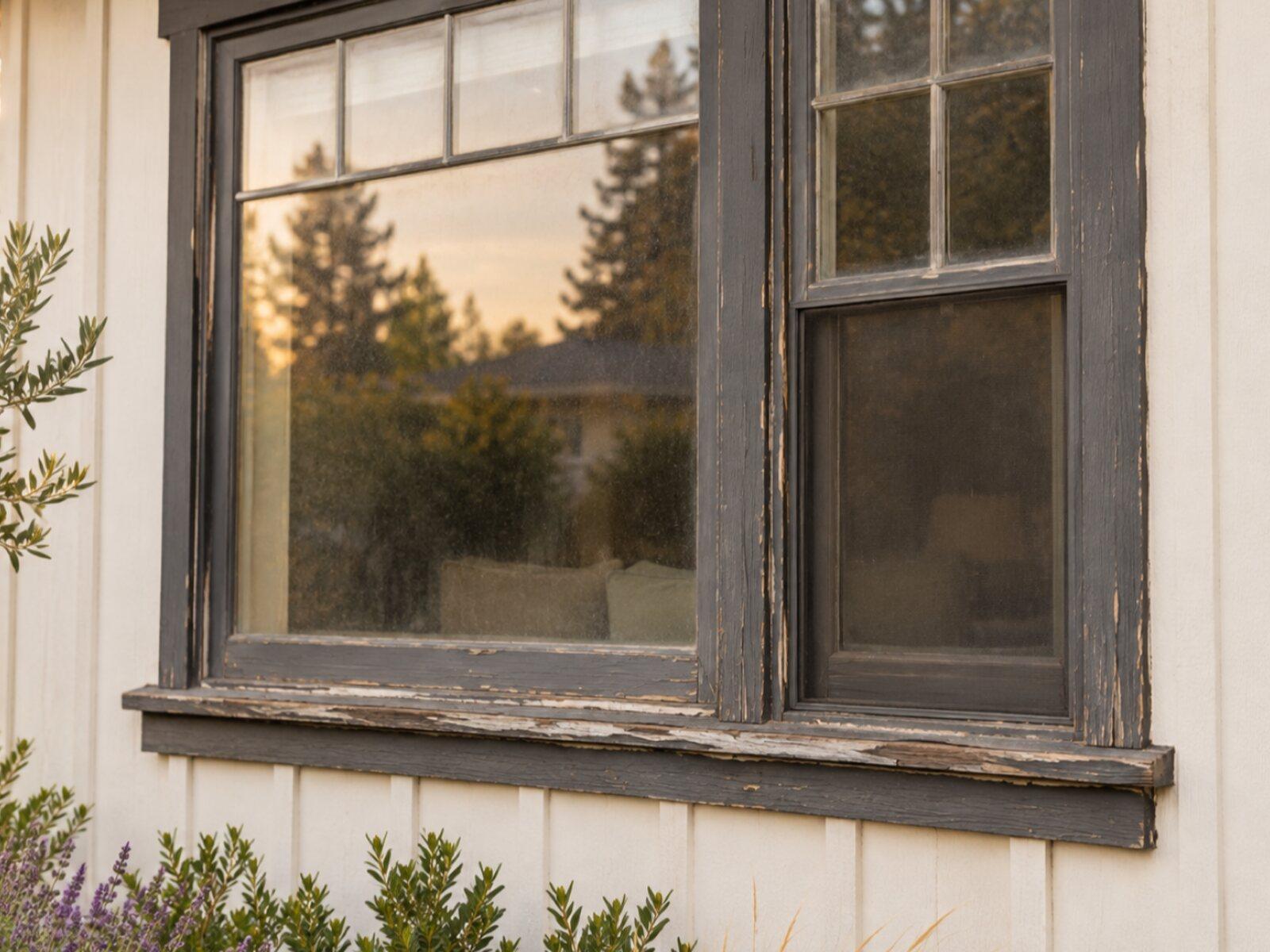
Keep a copy for your site visit or when comparing estimates.
Included in a written scope
- Probing and mapping of visible damage around the affected area
- Removal of decayed wood back to sound material
- Correction of the water path: flashing, drip caps, caulk joints, or grading, as identified
- New material installed, primed, and sealed at cuts and joints
- Finish paint on repaired areas where included, matched to existing color
- Protection and cleanup
Clarify before work starts
- How damage that extends past the visible area is priced once opened
- Whether paint on the repaired area is a match-in or a full section repaint
- Which flashing or siding changes are part of the repair
- Whether a pest inspection or report is involved
How a dry rot & trim project works
The stages to discuss when planning your project.
Talk through the project
Tell us what you want to repair or update. A few details about the home and what you have noticed are enough to start.
Review the home and options
A site review identifies the work involved, checks the usual trouble spots, and covers the choices that fit your home.
Agree on the scope and schedule
Review what is included, what is not, and how changes are handled before any work is scheduled.
Walk through the result
Review the completed work together, along with the applicable care and warranty information for what was installed.
Dry Rot & Trim questions from Rancho Cordova homeowners
Does dry rot repair need a permit in Rancho Cordova?
Not for a trim splice, fascia board, or sill nosing replaced in kind. It does once the rot reaches structure: rafter tails, eave framing, sheathing, a sill plate, a balcony ledger, or porch beams are permitted and inspected by the City of Rancho Cordova Building & Safety division. Siding is separate: the city publishes a residential siding permit application, so a repair that grows into replacing lap boards or a T1-11 panel is checked with the division first. Old-grid repairs often start as trim and end as structure once the piece is off, so the estimate says up front which lines would be permitted and who pulls the permit.
Why is the bottom foot of my T1-11 soft while the rest of the wall looks fine?
Because T1-11 is plywood with the end grain exposed at the bottom edge, and that edge wicks water into the plies every time a sprinkler, a splash, or a downspout wets it. The grooves channel water down to the same edge. Paint on the face holds up while the panel rots from the bottom, so the wall looks fine until a screwdriver sinks in. The repair cuts the panel back to sound wood and splices in new material with a flashed horizontal joint, or replaces the wall if the damage is wide, and the siding page explains when each makes sense.
My Anatolia stucco is stained at the base of the wall. Is that dry rot?
Often it is the start of it. Stucco walls drain through a weep screed at the bottom, and on the 2005-to-2015 tracts that screed is frequently buried under bark, soil, or a raised bed. Water then sits against the sill plate and the bottom of the framing instead of draining out, and the stain is the stucco wicking it. The site review clears the screed and probes the plate; if the plate is soft, that is a structural repair with a permit, stucco cutting, and a repaint to the HOA's approved color. Clearing the screed and moving the downspout is the fix when the plate is still sound.
How do I tell rot from termites on my Lincoln Village house?
Probe it and look at the pattern. Rot leaves wood soft, spongy, and crumbly along the grain with no tunnels; subterranean termites leave mud tubes on the foundation and galleries inside the wood. On the old grid they turn up together at garage jambs on the slab and corner boards near the ground, because both need the same wet wood. If there is any sign of insects, a licensed wood-destroying organism inspection comes before the repair; treatment is a separate California license from the contractor's license that covers the carpentry.
Can you save the original redwood on my 1960s Cordova Meadows house?
Usually, above the bottom course. Old-growth redwood lap and corner boards on these ranches are often sound where they have stayed dry, and the repair cuts out only the soft bottom sections and splices in new material with a scarf joint, primed and sealed at the cuts. Epoxy consolidation is worth it on a profile that is hard to match with limited damage, once the water source is fixed. Where the bottom course sits an inch from the concrete, it is replaced with fiber cement and given real clearance, because redwood set back into the same wet spot rots again.
How do you price damage you cannot see until the trim is off?
With unit rates agreed before anything comes off. A Rancho Cordova estimate prices the visible repairs by the piece and by the linear foot: a rafter-tail splice, a foot of fascia, a foot of T1-11 panel splice, the sill and framing under a 1960s slider. It carries a stated allowance for hidden damage at those same rates. When the trim is off and the probe finds more, the crew stops, photographs the opening with a tape in the frame, and prices the added footage at the written rate. The owner approves that count before the wall is closed, so the invoice is agreed rates times measured footage.
Will a rot repair in the Villages of Zinfandel need HOA approval?
A like-for-like repair painted to the approved color usually does not change anything the association reviews, but the color match itself has to be right, and any repair that changes a visible profile, replaces foam trim with a different shape, or alters a porch column goes to the architectural committee first. Anatolia's committee requires written approval for exterior modifications and says review can take up to 45 days; the Villages of Zinfandel has its own review. The estimate notes which lines are pure repair and which would need a submission.
Tell us about your Rancho Cordova dry rot & trim project.
Share what you have noticed and what you would like to change. We'll review the details and contact you about the next step.
No budget, address, or photos needed to inquire.
Other exterior services in Rancho Cordova
- Rancho Cordova siding replacementExplore repair and replacement options for your home's exterior walls.
- Rancho Cordova window & door replacementFind an updated look and a fit that works for your home.
- Rancho Cordova roof replacementPlan the next step for a worn or damaged roof.
- Rancho Cordova exterior paintingRefresh the finish, starting with the preparation underneath.
- Rancho Cordova gutter installationPlan how rainwater moves from the roof and away from the home.